

The Complete Travel Planning Checklist After 50
A practical preparation timeline for a calmer departure.
A trip is easier to enjoy when the important decisions have already been made. This planning guide is for U.S. travelers over 50 who want a comfortable, well-organized journey—whether it is a domestic flight, a road trip, or a vacation overseas. The goal is not to pack more into every day. It is to avoid preventable last-minute problems.
At a glance: Choose a manageable itinerary, review identification and entry rules, compare the full booking cost, prepare medicines and supplies, and save a simple departure checklist. The 30-day schedule below is a practical organizing tool—not a substitute for the earlier lead time needed for passports, visas or certain vaccinations.
The 30-day countdown at a glance
| When | Your main objective | Most useful action |
|---|---|---|
| More than 30 days out | Check what requires lead time | Verify passport, entry rules and medical needs |
| 30–21 days out | Confirm bookings and budget | Compare flight and hotel terms |
| 20–8 days out | Plan comfort and logistics | Arrange transport, assistance and a packing system |
| 7–2 days out | Verify details | Recheck documents, reservations and luggage rules |
| Departure day | Travel with fewer surprises | Review flight status and essentials |
Before the 30-day countdown: check long-lead requirements
Some important tasks should happen earlier than the final month. For international travel, check your destination’s passport validity, visa or entry requirements, and current travel advisory. Some countries require passports to remain valid for months after a planned visit; rules vary by destination and itinerary, so never assume one global six-month rule applies. If you need to apply for or renew a passport, begin early. The State Department checklist is a reliable starting point for U.S. citizens.
CDC recommends scheduling a destination-specific medical or travel-health consultation at least four to six weeks before departure where relevant. It can take time to assess vaccination and medication needs. This is particularly important if you have a chronic condition or a complicated itinerary; only your clinician can advise on your specific medical needs. See CDC’s before-travel advice.
30–21 days before departure: decide what kind of trip you want
- Set a comfort-first pace. Choose one or two essential activities per day rather than filling every hour; leave room for rest, meals and travel delays.
- Write down your non-negotiables. Examples: fewer transfers, walkable location, elevator access, quiet room, flexible cancellation or a direct flight.
- Compare total costs, not headline prices. Include baggage, seat selection, ground transportation, hotel fees, parking and taxes.
- Read the exact cancellation terms before booking. Take screenshots or save confirmation emails in one folder.
Flight booking rule worth knowing: Under the U.S. Department of Transportation’s airline requirement, for bookings made at least seven days before departure, an airline generally must offer either a 24-hour full-refund cancellation option or a 24-hour free hold. It does not have to offer both. This airline rule does not apply in the same way to tickets bought from third-party travel agents or online travel agencies. Verify the applicable carrier or seller policy before payment. Source: U.S. DOT refunds guidance.
20–8 days before departure: simplify your travel day
- Choose ground transportation: compare airport parking, taxi or rideshare cost and hotel transfers. Estimate time required at both ends of your trip.
- Confirm accessibility requests early: if you need mobility assistance, an accessible room or other accommodations, contact the airline or lodging provider rather than assuming availability.
- Plan a realistic connection: factor in terminal changes, walking distance, security and possible delays.
- Create a travel folder: save flight confirmation, hotel details, travel insurance documents, itinerary, and emergency contacts offline.

Keep the items you need most in one easy-to-find travel planning area.
7–2 days before departure: make the essentials easy to find
A packing system is more effective than a perfect-looking suitcase. Put your most important items in clear, reachable places. Your carry-on should contain items that would be difficult to replace quickly, subject to all TSA and airline rules.
- Identification and documents: verify the correct government ID for your route and make copies of essential international documents, stored separately from originals.
- Medications and supplies: confirm permitted quantities, labels and destination import rules; discuss your own needs with a pharmacist or clinician if necessary.
- Clothing: pack an outfit for the weather and activities you will actually encounter. Choose shoes you have already worn comfortably.
- Phone and charging: add important addresses to maps offline, set up your payment method, and charge your devices and power bank.
- Carry-on liquids: check TSA’s 3-1-1 rule for ordinary liquids and TSA’s separate screening guidance for medically necessary liquids.
- Last-minute checks: review hotel check-in time, flight status, airline baggage limits and any checked-bag fees.
TSA’s regular carry-on liquids guideline is containers of 3.4 ounces (100 mL) or less in one quart-size clear bag per passenger. Medically necessary liquids can have different screening procedures; review current TSA instructions rather than applying the ordinary liquids rule to essential medical supplies. See TSA’s item finder.
Your easy three-stage visual reminder
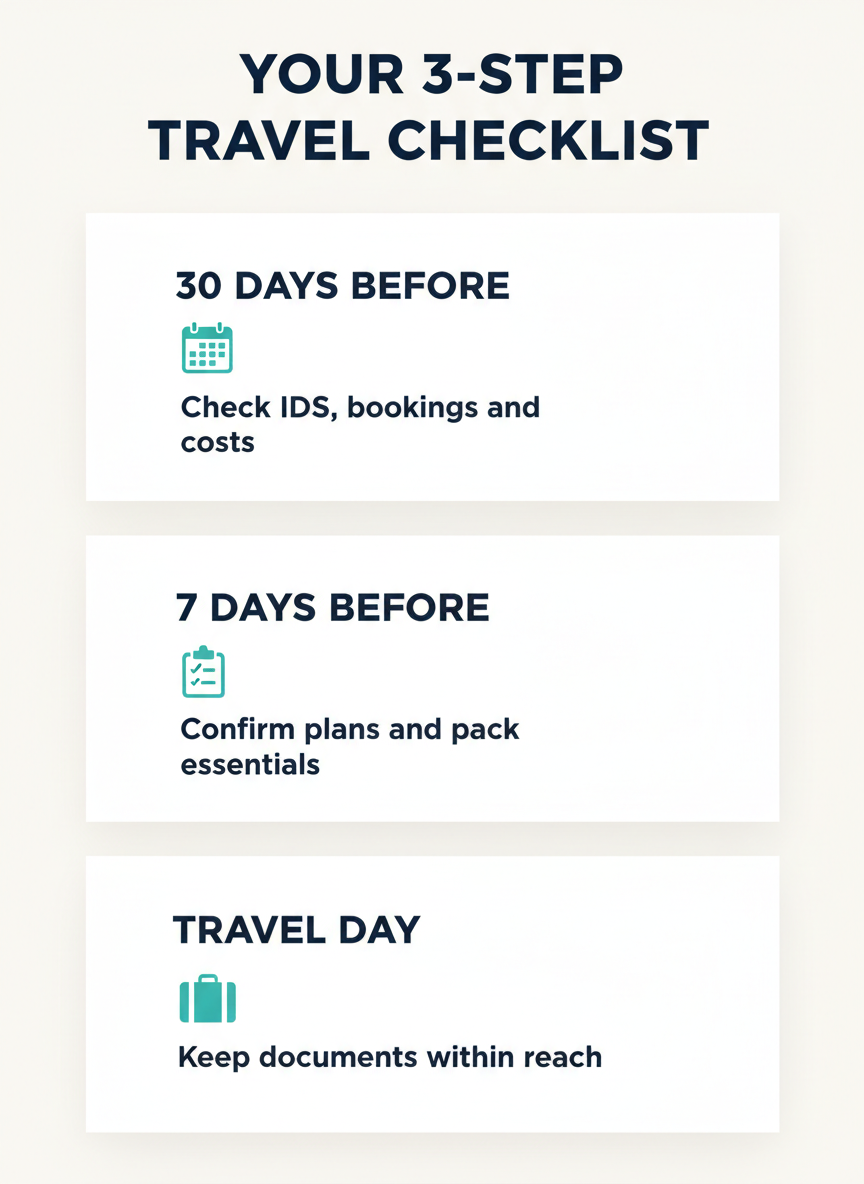
Stage 1 — Plan early
Confirm the destination, budget, required documents, and any health-related appointment you may need. Begin tasks with long processing times first.
Stage 2 — Verify everything
Re-read reservation conditions, check travel advisories, confirm accessible services and keep important contact numbers in one secure place.
Stage 3 — Make departure day simple
Put your travel documents and essentials in one known place, check transportation timing, and allow extra time without assuming every traveler needs the same routine.
Departure-day checklist
- □ Check airline, rail or road conditions and your confirmed departure time.
- □ Place your passport or acceptable ID and reservation details where you can reach them.
- □ Pack prescribed medicines, essential assistive items and chargers in an appropriate bag.
- □ Confirm baggage rules and size with your own carrier.
- □ Check the weather forecast and transportation route.
- □ Lock your home, secure valuables and share your basic itinerary with someone you trust.
- □ Leave enough time to move comfortably between each travel step.
Example: comparing two hotel options
Imagine a three-night stay. Hotel A costs $150 per night but has a $35 daily fee and a $50 airport transfer. Hotel B costs $175 per night, includes the fee and provides a free shuttle. Ignoring taxes and other differences, A totals $605 ($450 room + $105 fees + $50 transport), while B totals $525. The option with the higher nightly headline price can cost $80 less overall. Always use the exact terms for your dates and needs; this is a fictional illustration, not a current hotel offer.
Frequently asked questions
Is this checklist only for people who are 50 or older?
No. These preparation steps help travelers of many ages. The emphasis on comfort, clear decisions and manageable pacing reflects what this site’s readers tell us they want from a travel guide—not assumptions about anyone’s abilities.
Do I need to start planning exactly 30 days before I travel?
No. Thirty days is a useful organizer for many trips, but passport processing, some visas, vaccination schedules, cruises, accessibility arrangements or complex international plans can require substantially more time.
Does a refundable airline ticket mean every fee is refundable?
Not necessarily. Refund eligibility depends on the type of ticket, the seller, route, carrier and the reason for cancellation. Read the full terms and verify any U.S. DOT consumer protection relevant to your purchase.
The bottom line
A successful travel plan is one you can follow without rushing. Begin with long-lead requirements, compare total costs, protect important documents, and build in time for comfort. Bookmark this checklist and revisit it as your departure date approaches.
Official resources and verification
- U.S. Department of State — International Travel Checklist — destinations, passport and safety reminders
- U.S. Department of Transportation — Refunds — airline booking and refund rules
- Transportation Security Administration — What Can I Bring? — carry-on item restrictions
- CDC Travelers’ Health — Before You Travel — destination-specific health preparation
Editorial review: October 9, 2026. Airline rules, travel documents, government guidance, and personal circumstances can change. Recheck the linked official authorities and providers before departure.
Disclosure: This article provides general, research-based information. It is not individualized medical, legal, insurance or financial advice. No hotel, airline or product sponsor was involved in preparing this draft.
Related travel guides
- Organize Travel Documents — a practical guide for the next stage of planning.
- Carry-On Packing Essentials — a practical guide for the next stage of planning.
- Build a Realistic Vacation Budget — a practical guide for the next stage of planning.
Need a different topic? Browse all travel guides or start with our five-step overview.

