

How to Build a Realistic Vacation Budget After 50
Calculate the full trip cost and keep room for surprises.
A vacation budget should help you relax, not make every purchase feel stressful. The key is to decide what matters most for your trip, calculate a realistic total before you book, and leave room for surprises. This step-by-step guide is written for U.S. adults over 50 and anyone who wants a calmer, more comfortable travel experience.
In short: Choose a trip spending limit, break expenses into five categories, use the final price for each booking, and set aside a separate contingency amount. If you are saving in advance, divide your total trip goal by the number of months remaining. All dollar amounts below are fictional examples—not live airfare or hotel quotes.
1. Set a maximum you would feel comfortable spending
Before opening hotel or flight sites, decide on an upper limit based on your actual finances. Consider upcoming bills, household needs, savings goals and any existing debt. A holiday is easier to enjoy when you are not relying on money that is needed for essentials after you return.
- Choose an initial total budget for the entire trip, not just the accommodation.
- Write down the dates, number of travelers, destination and number of nights.
- Decide which elements matter most: a direct flight, a restful hotel, convenient location, memorable activities or time with family.
- Set a separate contingency that can cover some unexpected costs without putting necessary expenses at risk.
If a trip goal would require borrowing or cutting into essential reserves, consider adjusting its timing, duration or destination. The Consumer Financial Protection Bureau provides free tools for setting savings goals and working through a cash-flow budget. See CFPB’s budgeting and savings toolkit.
2. List the five categories that account for most travel costs
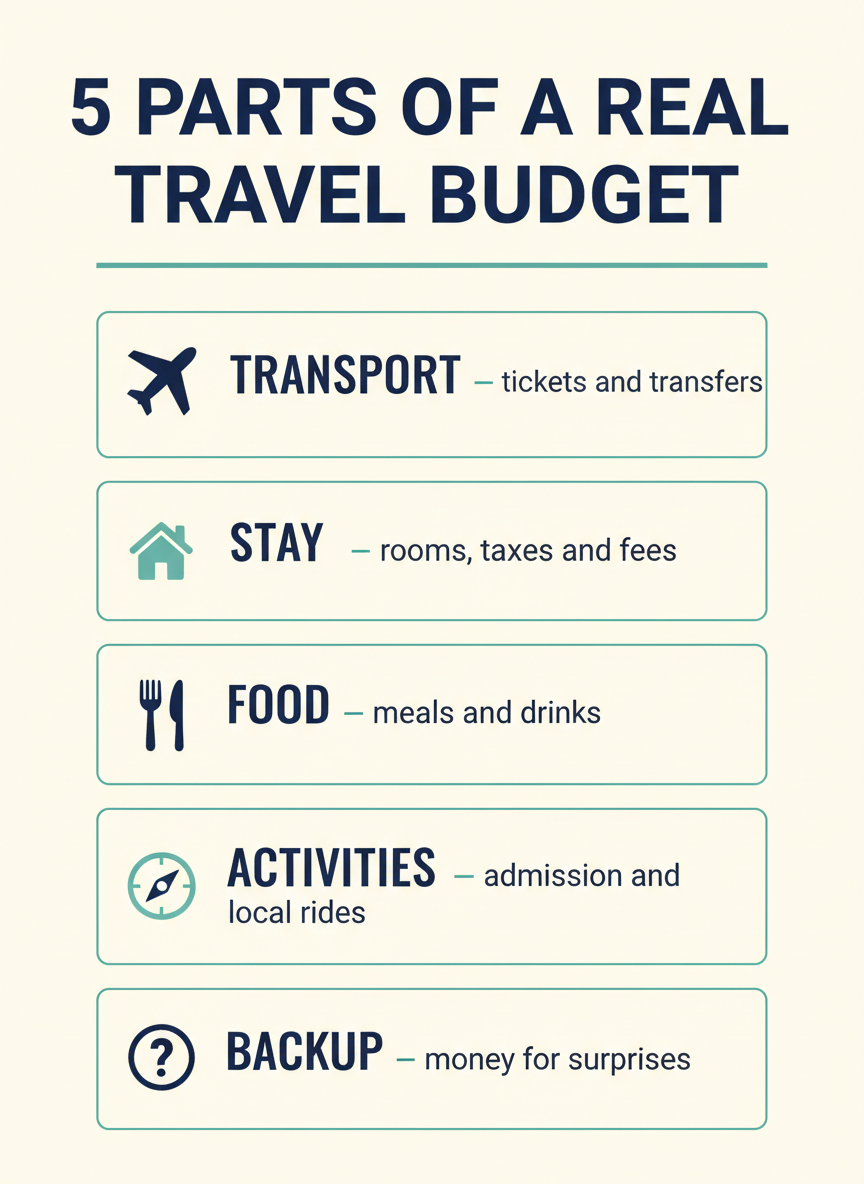
Transportation
For flights, include the ticket price plus only the extras your group actually needs, such as checked bags, preferred seats, airport transfers or parking. For a road trip, include fuel, tolls, parking and possible rental-car costs. Confirm the exact fare and baggage policy before you pay.
Lodging
Compare the full stay cost, including mandatory lodging charges and any government taxes due at checkout. The FTC’s U.S. rule on unfair or deceptive fees, effective May 12, 2025, generally requires sellers of covered short-term lodging to display upfront a total that includes mandatory charges known and calculable in advance. Certain charges such as taxes and optional extras may be listed later, but the final amount must be disclosed before payment. This does not make every property the same price or eliminate resort fees. See the FTC official rule FAQs.
Meals and everyday essentials
Estimate a realistic amount for breakfast, lunch, dinner, drinks and small necessities. If your hotel includes breakfast and you expect to use it, account for that in the meal budget. If you enjoy one special restaurant, allocate room for it instead of pretending every meal will be inexpensive.
Activities and local transportation
Include admission tickets, guided tours, public transit, taxis, rideshares and incidental transportation. Consider whether a bundled pass is truly a better value for the attractions you will actually visit rather than assuming every pass saves money.
Contingency
Unexpected expenses can include a delayed arrival, an extra taxi, an item you forgot to pack or a changed plan. A contingency is a self-chosen buffer; there is no universal percentage that fits everyone. If you return with it unused, that is a success—not money you must spend.
3. Example: a three-night trip for two adults
This worked example illustrates how to calculate a trip total. It is not an estimate of the cost of a specific U.S. destination. Your dates, accessibility needs, booking conditions and service choices may result in very different amounts.
| Expense | Illustrative trip cost | What is included |
|---|---|---|
| Round-trip transportation for two | $480 | Sample fares and planned bags |
| Lodging, three nights | $540 | Example total room charge before government taxes |
| Lodging taxes | $65 | Illustrative taxes |
| Meals and everyday spending | $240 | Meals and small necessities |
| Activities and admissions | $120 | Selected paid activities |
| Local transportation | $80 | Transfers and short trips |
| Contingency reserve | $175 | Optional buffer for surprises |
| Total planned budget | $1,700 | All listed categories included |
How the total works: $480 + $540 + $65 + $240 + $120 + $80 + $175 = $1,700. The contingency is included in the budget, not added again at the end. A $200 deposit toward the hotel is an advance payment toward the lodging cost, not a new extra $200 expense if it is already included in the total.
4. Turn the budget into a simple savings plan
Once you have a target, divide the amount you still need to save by the number of months before booking or departure. If the $1,700 trip is eight months away and you are starting with no trip savings, the example monthly target is $212.50. If you already set aside $500, the remaining $1,200 would mean $150 per month for eight months.
- Keep a clear record of what has already been paid and what is still due.
- Use regular transfers to a dedicated savings space if that helps you stay organized.
- Review the target if prices change or other priorities become more important.
- Do not assume reward points, vouchers or credits are worth cash until you verify their redemption conditions.

Separate estimated costs, paid deposits and balances still due to avoid double counting.
5. Find the real price when comparing flights and hotels
Many online prices change by date, occupancy, fare type and optional extras. Comparing two offers requires matching like-for-like conditions. Check the total checkout amount for the same travel dates and the same number of people.
- Choose identical dates and traveler counts.
- Compare equivalent room types, baggage allowances and transport routes.
- Include mandatory fees and known taxes; add optional expenses that you actually plan to purchase.
- Review cancellation, prepayment and change conditions.
- Save the quoted terms before you complete a booking, then update the budget with actual paid amounts.
If you use a vacation rental, verify that the listing is genuine before sending money. The FTC warns that fake and copied rental listings can lead to significant losses. Avoid sellers who insist on gift cards, wire transfers or cryptocurrency, and confirm the property and contract details. See FTC advice on travel scams.
6. Match your money to your comfort priorities
Saving money is valuable, but so is protecting the parts of the trip that matter to you. For some travelers, a nonstop flight or a hotel near an attraction can reduce stress and ground-transport expenses. For others, a longer stay in a quieter neighborhood may be the better use of money.
| Tradeoff | Potential benefit | Check before deciding |
|---|---|---|
| Higher-price nonstop flight | Less connection stress | Total price and arrival time |
| Central hotel | Less transportation cost or walking | Room comfort and final stay charge |
| Hotel with included breakfast | Simpler mornings | Whether it truly fits your routine |
| Fewer scheduled attractions | Lower admissions and less rushing | Which experiences matter most |
| Travel off-peak | Possible lower prices | Weather, business hours and access |
Avoid assuming that one age group wants only expensive accommodations, cruises or organized tours. Your preferences and needs—not a stereotype—should guide the budget.
7. Watch for costs people commonly forget
- Airport parking, hotel parking and valet charges.
- Optional baggage and advance seat selection.
- Ground transportation from the arrival airport.
- Taxes and separately priced optional services.
- Travel documents and any necessary visa fees.
- International roaming, adapters and payment conversion charges.
- Travel insurance or protection plans, if you choose them, including important exclusions.
- House-sitting, pet care or other expenses at home while away.
- Changes to bookings, missed connections and discretionary shopping.
Insurance products are not interchangeable, and coverage conditions vary widely. Read the actual policy, exclusions and claim process before deciding whether to purchase. This informational guide does not recommend an insurer or provide personalized coverage advice.
8. Use a short budget review before paying
- Can I afford the complete trip, including the contingency, without compromising essentials?
- Have I checked the total charge and refund or cancellation terms?
- Are all travelers and relevant accessibility needs reflected in the quote?
- Have I counted deposits only once?
- Are unfamiliar offers or payment instructions verified and legitimate?
- If the actual cost exceeds my limit, what can I change before booking?
Frequently asked questions
What is a good vacation budget for people over 50?
There is no universal correct amount. The appropriate budget depends on your resources, destination, timing, comfort needs and priorities. Build from the trip you want and the total you can comfortably afford.
Should I budget for taxes if a hotel shows a total price?
Yes. U.S. covered short-term lodging advertising must generally include calculable mandatory charges in its upfront total, but government taxes and certain optional charges may be displayed later before checkout. Always confirm the final payable amount.
Are travel deposits an additional cost?
Usually a deposit counts toward the agreed cost when it is credited against the final bill. Treat it as an advance payment, not an extra cost, unless the terms say otherwise. Some separately refundable security deposits are temporary holds rather than trip expenses, but they may still tie up available funds.
How much contingency money should I set aside?
Choose a buffer that fits your circumstances. A simple approach is to list the most plausible unexpected costs for your itinerary, then decide on an amount you can comfortably reserve. No fixed percentage works for every trip.
Official references and editorial review
- CFPB — Your Money, Your Goals (budgeting and savings worksheets).
- FTC — Unfair or Deceptive Fees Rule FAQs (hotel and vacation rental total-price disclosures).
- FTC — Avoid Scams When You Travel (common fake booking and travel payment scams).
Reviewed: October 9, 2026. Rules and booking conditions can change. All dollar amounts are fictional examples, not actual quotes, projections or current market averages.
Disclosure: This is general, independent travel-planning information, not personalized financial or legal advice. No hotel, booking platform or financial product is endorsed or promoted.
Related travel guides
- Choose a Comfortable Hotel — a practical guide for the next stage of planning.
- Relaxed Three-Day Getaway — a practical guide for the next stage of planning.
- Comfortable Road Trip Planning — a practical guide for the next stage of planning.
- Avoid Travel Booking Scams — check warning signs and safer payments before booking.
Need a different topic? Browse all travel guides or start with our five-step overview.

