

How to Choose a Comfortable Hotel After 50
Compare comfort, total price, location and booking conditions.
A hotel that looks attractive in photos may not be the right place for your trip. The best choice is the property that fits your plans, budget, comfort priorities and individual needs. This guide offers a practical way for U.S. travelers over 50—and anyone who values clear decisions—to compare lodging without becoming overwhelmed by booking websites.
Quick answer: Before reserving, compare four things in this order: (1) location and travel time, (2) the final price for your dates, (3) the actual room features and services you need, and (4) the cancellation and payment conditions. Use the same dates, room occupancy and inclusions for every comparison.
1. Choose a location that simplifies your day
Start with the places you will actually visit, not a neighborhood’s reputation alone. A hotel farther from the sights may look cheaper but add transportation costs and longer travel times. Use a map to estimate your trip from the station or airport and to any planned activities. Check whether the route involves stairs, steep slopes, long walks or infrequent public transport if these matter to you.
- Pin two or three destinations you expect to visit.
- Compare actual travel routes and time, not just straight-line distance.
- Check the last-mile connection from the airport, station or parking area.
- If quiet evenings matter, look for recent reviews mentioning street noise or room placement.
Try this: Write down the number of days you will stay, your two most important destinations, and whether you prefer public transit, driving or taxis. This turns a vague location decision into a practical comparison.
2. Compare the total price—not just the nightly rate
A nightly price can leave out important details. In the United States, the Federal Trade Commission’s Rule on Unfair or Deceptive Fees took effect May 12, 2025. It requires covered short-term lodging sellers to prominently disclose a total price including mandatory fees they can calculate upfront, while government charges such as taxes and selected optional add-ons can be disclosed later before payment. The rule does not prohibit fees; it addresses how prices and fees are presented. Read the FTC official explanation for details.
| Example: three-night stay | Hotel A | Hotel B |
|---|---|---|
| Advertised nightly room rate | $145 | $166 |
| Room subtotal (3 nights) | $435 | $498 |
| Mandatory nightly fee | $30 × 3 = $90 | Included |
| Airport transfer | $55 | $0 shuttle |
| Total before taxes | $580 | $498 |
Result: In this fictional illustration, Hotel B costs $82 less before taxes despite its higher nightly room rate. This is not an actual hotel offer. Local taxes, optional charges and transport choices could change the comparison.
Before clicking Pay, review the checkout total and any separate charges for parking, pets, breakfast, extra guests, early check-in, cancellations or deposits. If something is unclear, ask the property or platform for written confirmation. Always take a screenshot of the booking terms that apply to your reservation.

Compare the same dates, guest count and included amenities before deciding.
3. Decide which room features are essential
There is no single ‘best’ hotel room for everyone over 50. Start with personal comfort preferences rather than assumptions about age. A comfortable choice might mean a quiet room, more space for luggage, an elevator, easy access to breakfast or a separate place to sit.
- Sleep: bed type, blackout curtains, temperature controls, noise and room position.
- Daily convenience: elevator access, floor level, nearby food, Wi-Fi, accessible electrical outlets and in-room storage.
- Bathroom: layout, shower or bathtub preference, lighting and non-slip surfaces.
- Mobility and accessibility: check the specific accessible features you require rather than relying on the word ‘accessible’ alone.
- Service: check-in hours, assistance with luggage and any shuttle schedule.
Accessible rooms deserve specific questions. Under ADA Title III, covered lodging providers must give enough information about accessibility features in hotels and guest rooms for guests with disabilities to assess whether a particular room meets their needs. Reservations rules also address holding reserved accessible rooms. Ask about the exact door clearance, bathroom setup, shower arrangement and route from entrance to room if relevant. See the U.S. Department of Justice ADA Title III regulation.
4. Examine cancellation, prepayment and refunds
A hotel described as ‘flexible’ may still have a specific local deadline, rate restriction, or payment requirement. Read the policy for your selected rate and dates, not just the site’s general help page. Some bookings are nonrefundable; others may allow cancellation until a certain day or hour, with a different charge after that deadline.
- Check whether your exact room rate is refundable or nonrefundable.
- Note the cancellation deadline, including the property’s local time zone.
- Find out when your card will be charged and whether the hotel requires a deposit or security hold.
- Check whether a third-party booking platform handles the refund, or whether you must contact the property.
- Save the booking reference and all messages about modifications or special requests.
If a trip is weather-sensitive or dependent on uncertain dates, a slightly higher flexible rate might be worthwhile. However, it is not automatically better. Compare the total price difference with the specific financial risk you are willing to accept.
5. Read reviews as evidence—not as a vote count
Review scores are a useful starting point, but individual reports can be more revealing. Look for several recent reviews from guests who describe circumstances similar to yours. Search for specific terms such as quiet room, elevator, mattress, parking, air conditioning and cleanliness. A single poor review does not prove a persistent issue; repeated, specific complaints deserve a closer look.
- Check the dates of the most useful reviews.
- Compare reviews across more than one platform when practical.
- Separate preferences (e.g., decor) from functional problems (e.g., broken lift).
- Contact the hotel for critical details rather than guessing from old photos.
6. Make a four-point booking checklist
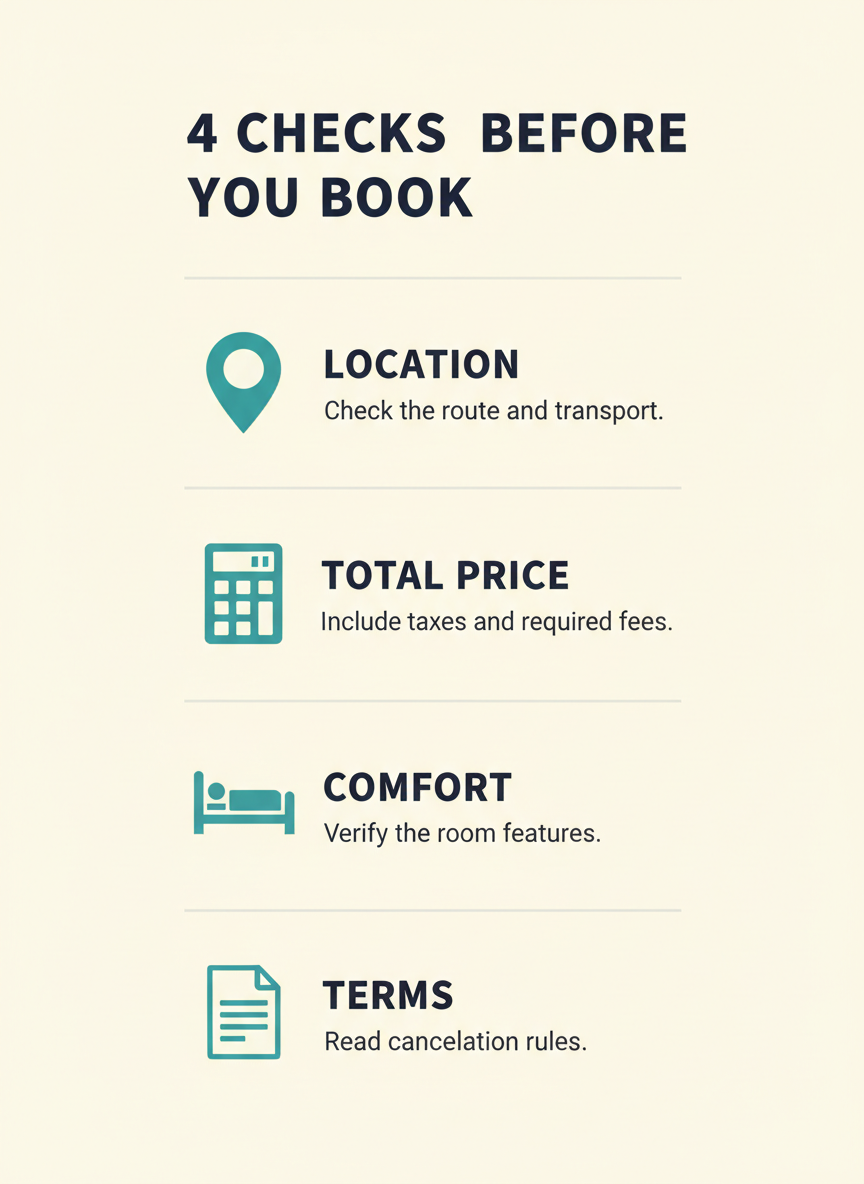
To keep the decision simple, score each candidate from 0 (does not fit) to 2 (fits well) for each criterion. This is an editorial organizing tool, not a professional hotel rating system.
| Criterion | Hotel A | Hotel B |
|---|---|---|
| Convenient location (0–2) | 2 | 1 |
| Acceptable total price (0–2) | 1 | 2 |
| Required comfort features (0–2) | 2 | 2 |
| Suitable cancellation terms (0–2) | 0 | 2 |
| Example total | 5 / 8 | 7 / 8 |
The higher example score suggests Hotel B may fit the stated priorities better, but it should not override a non-negotiable feature. If wheelchair access, a particular bed setup or a step-free route is essential, confirm it directly before paying. You may prefer a weighted checklist if one criterion matters much more than the others.
7. Confirm the reservation directly
- Double-check the booking dates, number of guests, room category and total price.
- Record the hotel’s address, check-in time, confirmation code and contact phone.
- If you made an accessibility or other essential request, ask the property to confirm the specific reservation details in writing.
- Check that the confirmation email matches what you purchased.
- Reconfirm important arrangements shortly before departure.
Booking safely: use known hotel or reputable reservation sites, be cautious about off-platform payment requests, and avoid sending full payment card details through ordinary email.
Frequently asked questions
Do all hotels have to include taxes in the first advertised price?
No. Under the FTC rule, taxes and other government charges may be excluded from the initially displayed total price, but relevant excluded charges must be disclosed before a consumer is asked to pay. Always read the final checkout amount and any separately described charges.
Does ‘ADA accessible’ mean a room has every feature I may need?
No. Accessible room designs and amenities vary. Check detailed feature descriptions, then ask the property to confirm the exact amenities and reservation arrangements important to you.
Is booking directly with a hotel always cheaper?
Not necessarily. Compare the final price, refund policy, included services and loyalty benefits for the same room and dates. A third-party deal may be useful, but it may also come with different support or cancellation procedures.
How far ahead should I book?
There is no universal best booking window. Popular dates, limited accessible-room inventories, events and refundable rate options can make early planning valuable. Compare real offers for your actual dates rather than relying on a fixed rule.
Before you book: the five-minute decision
Choose the hotel that meets your must-have requirements, minimizes unnecessary travel, offers a clearly understood final price and has terms you are comfortable accepting. If a booking condition is unclear, ask the property before completing payment. The right hotel is the one that works for your trip, not the one with the highest star rating.
Official sources and review date
- Federal Trade Commission — Rule on Unfair or Deceptive Fees FAQs (mandatory lodging fees, final price and exceptions).
- U.S. Department of Justice — ADA Title III regulations (hotel reservation and accessibility information).
Reviewed: October 9, 2026. Hotel prices, payment policies, accessibility features and regulations can change. Confirm the details for your specific reservation. Examples are fictional and for illustration only.
Editorial disclosure: This draft is independently researched and educational. We have not personally tested the hotel examples and do not book hotel rooms. No affiliate or sponsor recommendations are included.
Related travel guides
- Build a Realistic Vacation Budget — a practical guide for the next stage of planning.
- Relaxed Three-Day Getaway — a practical guide for the next stage of planning.
- Complete Travel Planning Checklist — a practical guide for the next stage of planning.
Need a different topic? Browse all travel guides or start with our five-step overview.

