
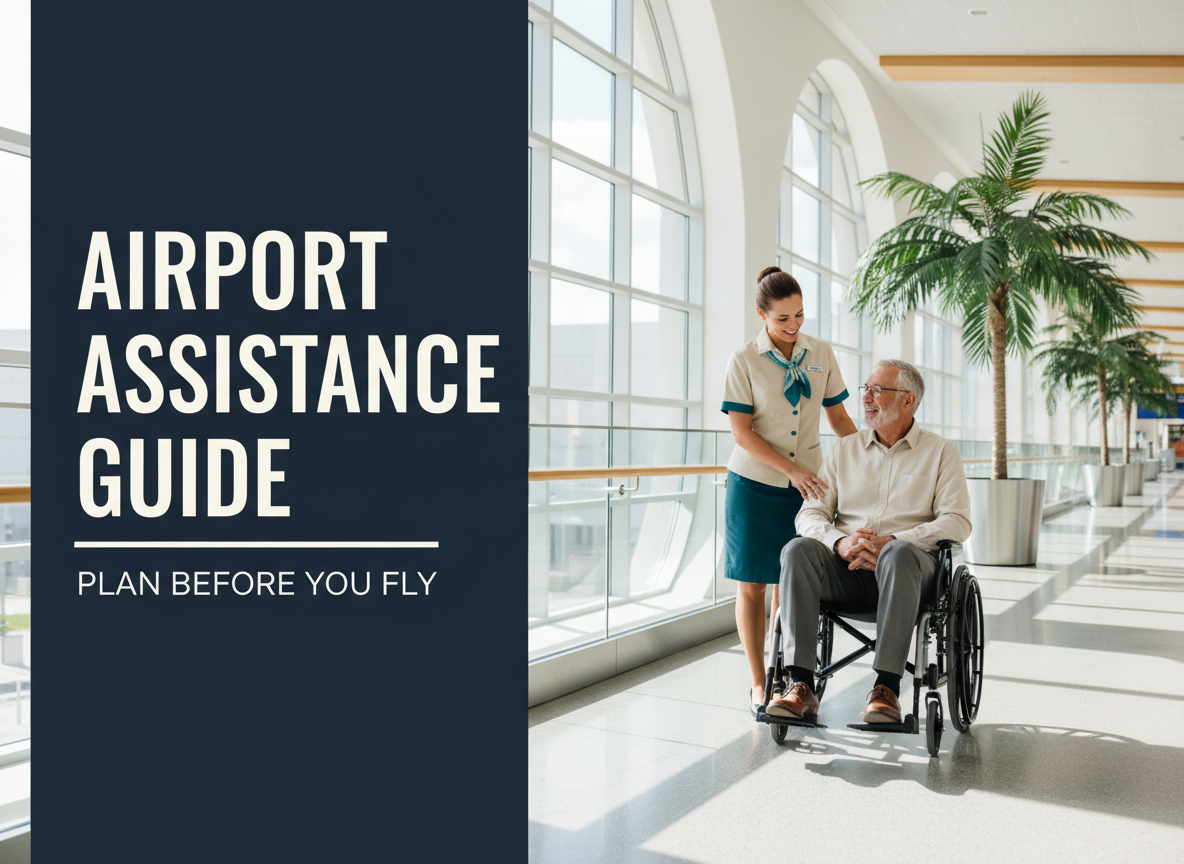
How to Request Airport Assistance Before You Fly
Know how to request airline assistance and TSA screening help.
Airports can involve long walking distances, busy security checkpoints, and short connections. If you have a disability and need help navigating an airport, you do not have to figure it out alone. U.S. aviation rules protect many types of disability-related support, and you can take practical steps before the flight to make arrangements clearer. This guide is for U.S. air travelers of any age, with special attention to readers over 50 who prefer structured travel preparation.
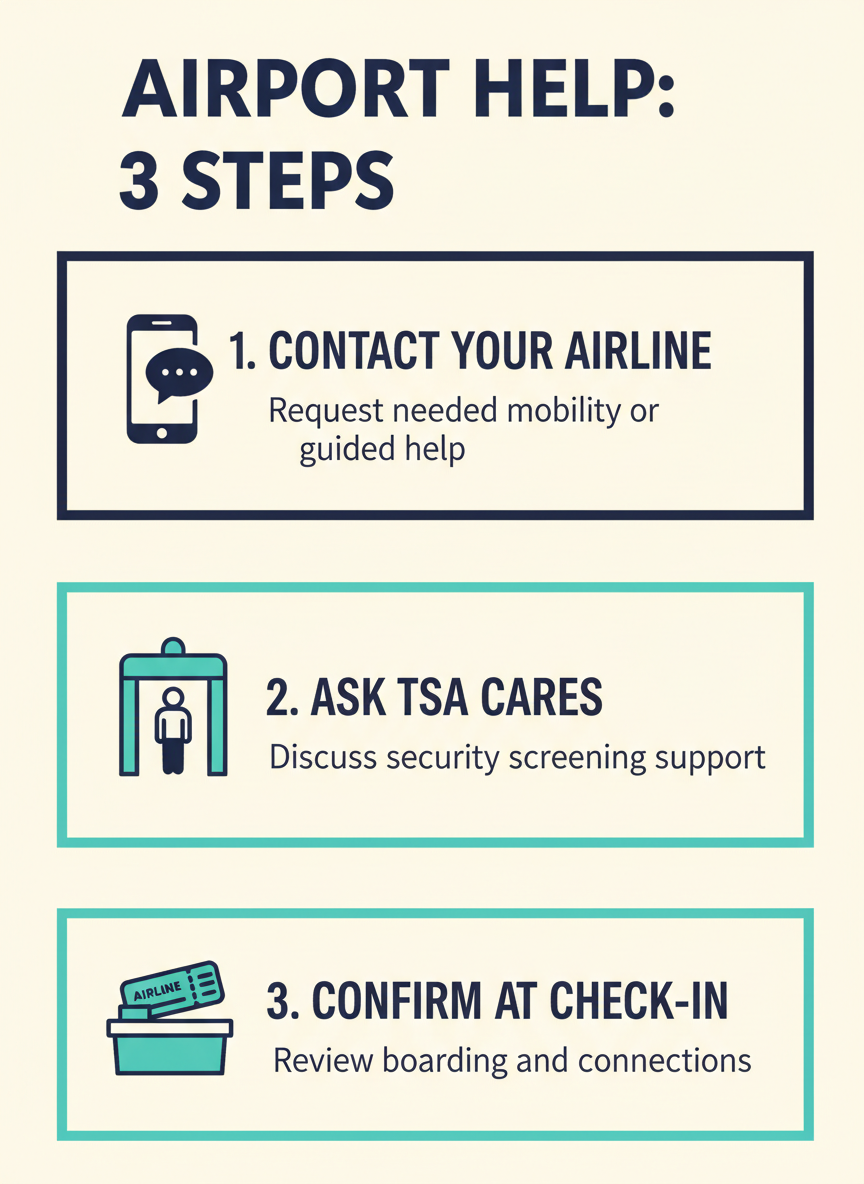
Quick answer: Contact your operating airline before travel to request wheelchair or guided assistance, explain exactly where you need help, and note any mobility devices or connection needs. At the airport, identify yourself to airline staff and confirm the arrangement. For help specifically with TSA security screening, contact TSA Cares; it is a separate service from airline wheelchair assistance.
1. Know which organization provides which type of help
The distinction matters. Airlines are responsible for many required disability-related accommodations for boarding, connecting, or leaving an aircraft. TSA manages screening at the security checkpoint. Your airport, contractor staff and operating airline may coordinate certain steps, but a request to one provider does not automatically guarantee a request to the other.
| Who to contact | What to discuss | When to make contact |
|---|---|---|
| Operating airline | Wheelchair or guided help, boarding and connections, accessible seating or stowage of assistive devices | Before travel, then identify yourself on arrival |
| TSA Cares | Questions or assistance with the security-screening process | Preferably at least 72 hours before travel |
| Airport or terminal | Parking, accessible routes and facilities outside airline services | Before departure, if relevant |
| DOT consumer protection | Rights information and complaint process | If airline accommodation problems cannot be resolved |
For authoritative airline rights, see the U.S. DOT Airline Passengers with Disabilities Bill of Rights and DOT Wheelchair and Guided Assistance guidance.
2. Request assistance from the airline
When making or reviewing a reservation, find the airline’s special-assistance or accessibility contact option. Explain what you need the staff to do, instead of relying on a vague note such as ‘special help.’ The operating airline—not necessarily the ticket-selling platform—should know your requirements.
- Which airport and flight date is involved.
- Whether you need guided assistance, a wheelchair, or help moving between terminals.
- Where you want assistance to begin: terminal entrance, check-in, security, gate or other permitted point.
- Whether you can walk limited distances or require an accessible transfer process.
- Whether the itinerary includes connections, and what support you need at each airport.
- If you use your own mobility device, the relevant dimensions, battery type and handling instructions.
Advance-notice nuance: For many disability-related accommodations, airlines cannot generally require advance notice as a condition of service, although advance arrangements can make execution smoother. Certain services or equipment can lawfully require advance notice—often up to 48 hours—and specific check-in arrangements. Do not assume a universal 48-hour rule applies to every wheelchair or guided-assistance request. Check the particular service in DOT Travel Tips for Persons with Disabilities.
3. Ask about seating and your own mobility device
If you need an accommodation because of a disability, contact the airline rather than guessing from seat-selection maps. Seating, on-board aisle chairs and stowage of wheelchairs or other assistive devices may be subject to different rules and practical aircraft limitations. Record the assistance request and any confirmation numbers.
Before checking a wheelchair or scooter, document its condition and follow the airline’s instructions for safe battery and equipment handling. Some devices require disconnection, protective packaging or special arrangements depending on their design. Request details specific to your equipment rather than making assumptions about all mobility aids.

Keep the airline accessibility contact, reservation details and requests accessible on your phone.
4. Contact TSA Cares for checkpoint screening assistance
TSA Cares is designed to help travelers with disabilities, medical conditions and other needs understand security screening and request available assistance. TSA recommends making your request at least 72 hours before travel for support from a Passenger Support Specialist at the security checkpoint. Availability and procedures can vary by airport.
- Contact TSA Cares using the official online request form or call 1-855-787-2227.
- Ask about the screening process for your situation without disclosing more medical information than necessary.
- Explain any concerns about mobility aids, assistive devices or other screening-related needs.
- Bring accessible documentation only when it is appropriate and required; a TSA notification card can help communicate but does not exempt anyone from screening.
- At the checkpoint, ask for a supervisor or passenger support staff if you encounter a problem.
TSA Cares does not itself arrange your airline’s wheelchair escort from a drop-off point all the way to your plane. For that service, coordinate with the airline. See TSA Travel Tips for the distinction between assistance and security screening.
5. Identify yourself at the airport
An advance request is helpful, but it does not replace presenting yourself to airline staff. DOT guidance says passengers requesting assistance must identify themselves as needing the service upon arrival. Ask where the assistance staff will meet you, especially if you are being dropped off at an airport entrance.
- Leave time for transport and the airline’s required check-in steps.
- At the appropriate airline counter or designated contact location, say that you requested disability-related assistance and give your reservation details.
- Explain the specific support you need today. You do not need to accept a form of help you did not request simply because it is easiest for staff.
- Check that assistance is planned for your connections and your final arrival airport, not just departure.
- Keep the confirmation and relevant contact information where you can retrieve it easily.
6. Plan connections and boarding
If changing planes, confirm that support is arranged from the arriving seat through the connection and onto the next flight when needed. The airport route may involve terminals, lifts, security or immigration. Ask airline personnel how the assistance transfer will work at each step.
DOT says passengers with disabilities can request assistance for moving through terminals and boarding, including proper help during connections. The details vary, so ask about the specific transfer process and who will meet the flight. For more information, see DOT guided assistance.
7. Know what to do when assistance is delayed or unavailable
If you cannot locate the help you requested, speak to an airline employee as soon as possible. Explain the immediate problem and describe what assistance is missing. Airline staff can identify the relevant service contact and you may ask for the airline’s Complaints Resolution Official (CRO), a specialist required under DOT rules for disability-related complaints.
- Keep the flight information, approximate time and names of people you spoke with if available.
- Ask for an alternative arrangement suitable for your own needs, rather than simply being told to wait without information.
- If the issue relates specifically to TSA screening, ask for supervisory TSA personnel.
- For suspected violations of the Air Carrier Access Act, review DOT’s Traveling with a Disability guidance and complaint channel.
2026 legal update: In August 2026 DOT extended an enforcement pause for several provisions of newer wheelchair-related regulations through April 30, 2027, including selected liability, training, notification and fare-difference reimbursement rules. This does not eliminate longstanding airport assistance obligations, but specific remedies may differ while the enforcement policy remains in place. See DOT’s August 4, 2026 update.
A ready-to-use assistance request script
Suggested message to your airline: “I have a flight on [date], confirmation [reference]. I need [wheelchair/guided assistance] from [starting point] to [gate or airplane seat], and assistance during my connection at [airport] and on arrival at [destination]. Please explain where I should report at the airport, whether any advance arrangements are required, and how my request will be confirmed.”
If you use your own wheelchair, state that clearly and ask about the relevant storage, battery and safe handling requirements. If traveling with another person, explain whether you need assistance independently.
Practical departure checklist
- □ Airline booking and assistance requests confirmed where possible.
- □ Operating airline, airports and flight numbers identified.
- □ Check-in and airport arrival arrangements understood.
- □ TSA Cares contacted in advance if you need checkpoint assistance.
- □ Mobility device needs and relevant equipment details communicated.
- □ Connections and destination assistance requested.
- □ Copies of contact details saved securely and accessible offline.
- □ Airline and DOT channels identified in case of problems.
Frequently asked questions
Does every traveler over 50 qualify for wheelchair assistance?
Age alone does not establish disability-related legal eligibility. These protections are connected to disability and service needs, not a birthday. Airline customer service may offer other services, but do not assume those are required or free.
Do I need to request airport assistance 48 hours in advance?
Not for every service. DOT says advance notice is generally not required for many accommodations, although certain specific services may permit notice requirements. Requesting help early is still a practical way to coordinate what you need.
Is TSA Cares the same as the airline’s wheelchair service?
No. TSA Cares addresses checkpoint screening assistance and questions. Airline disability assistance covers other parts of the journey, such as navigating the airport, boarding and making connections.
Can I contact someone if the wheelchair or assistance does not arrive?
Yes. Notify airline personnel, and ask for the airline’s Complaints Resolution Official if you believe disability-related services are not being provided as required. For unresolved issues you can consult DOT’s consumer protection resources.
Official references and review
- DOT — Airline Passengers with Disabilities Bill of Rights (airline accessibility rights).
- DOT — General Travel Tips for Persons with Disabilities (planning, notice rules and accommodations).
- DOT — Wheelchair and Guided Assistance (airport and connecting-flight help).
- TSA — TSA Cares (security-screening support requests).
- DOT — What’s New (August 2026 enforcement announcement and current developments).
Reviewed October 9, 2026. Airline policies, government regulation and enforcement practices can change. Verify with the operating carrier and the relevant official authority for the specific trip.
Editorial disclosure: This guide provides research-based general information and does not create an attorney-client or medical relationship. No airline or mobility equipment manufacturer sponsored the content.
Related travel guides
- Compare Flights with Confidence — a useful companion guide.
- Carry-On Packing Essentials — a useful companion guide.
- Organize Travel Documents — a useful companion guide.
Explore all travel guides or follow our five-step starting plan.

