

How to Compare Flights Without Getting Overwhelmed
Check price, connections, baggage and the terms before booking.
Flight searches can show dozens of routes, slightly different fares, unfamiliar terms and confusing filters. More options do not automatically produce a better choice. For U.S. travelers over 50—and anyone who wants a calmer booking experience—the goal is to identify two or three realistic itineraries, then compare the costs and conditions that actually affect the trip.
Quick answer: Compare five items in one simple chart: total fare and essential extras, baggage allowance, stop count and connection time, the full travel-day schedule, and change or refund conditions. Do not assume that a low initial fare is the lowest total cost.
1. Decide what matters before opening a flight search
Start with dates and the level of flexibility you genuinely have. Next, write down your non-negotiables. If a direct flight is worth paying more for, or you need a departure after a certain hour, filter for it early. A shortlist of two or three flights is easier to assess than 30 browser tabs.
- Preferred departure and arrival window.
- Nonstop flight or a maximum number of connections.
- Maximum acceptable total travel time, including airport time and ground transport.
- Cabin baggage and checked-bag needs for each traveler.
- Any accessibility or assistance needs that require planning.
- Budget ceiling for the complete itinerary—not just the first advertised price.
2. Use the full ticket price and add only the extras you need
In U.S. air travel advertising, required taxes and mandatory charges are generally included in the displayed full airfare. Optional items such as checked luggage, some carry-on allowances, seat selection or upgrades may cost extra depending on your ticket. The U.S. Department of Transportation has rules on disclosure of fares and fees. See DOT airline rules and fares.
Important 2026 update: A DOT final rule issued in July 2026 restored the previous ancillary-fee disclosure framework after a court vacated the department’s 2024 enhanced disclosure rule. Do not rely on articles that assume the original 2024 disclosure requirements still apply unchanged. Carriers and ticket agents must still alert customers that additional baggage charges may apply and identify where these can be found. Check the airline’s actual posted fee information before purchase. Source: DOT 2026 final rule.
| Illustrative example, one traveler | Flight A | Flight B |
|---|---|---|
| Base fare with mandatory charges | $220 | $255 |
| Checked bag | $45 | Included |
| Preferred seat | $35 | Included |
| Total for these needs | $300 | $255 |
| Stops | One connection | Nonstop |
These are fictional figures for comparison, not live fares. In this example, Flight B has the higher headline airfare but saves $45 and avoids a connection because the traveler planned to buy one checked bag and seat selection. Your result could be different if you do not need those extras.
3. Compare total travel effort, not just the time in the air
A trip’s duration includes travel to the airport, check-in, security screening, boarding, connections, arrival and the final trip to your accommodation. A cheaper itinerary with an inconvenient connection can create a tiring travel day. If you value a slower pace, consider the total effort along with price.
- Check whether a connection requires a terminal or airport change.
- Look at the layover in relation to immigration, security screening and walking distance, where relevant.
- If you need assistance, request it through the airline; do not assume a tight connection will work.
- Compare the arrival time with hotel check-in and availability of safe, convenient transportation.
- Avoid treating a short connection as automatically ‘best’ or a long connection as automatically ‘worst’.
For passengers with disabilities, DOT guidance explains that airlines must provide certain forms of airport and boarding assistance when requested, subject to safety rules and specific conditions. Advance contact is helpful for planning even when advance notice is not generally required. See DOT travel tips for passengers with disabilities.

Shortlist two or three options, then check the total journey—not just the search-result price.
4. Read the fare rules and identify who sells the ticket
A ticket purchased directly from an airline and a ticket purchased through an online travel agency may differ in customer service, booking changes and refund processing. Read the terms before paying and note who will be responsible if you need to cancel.
- Open the final checkout view for your selected itinerary.
- Verify dates, airports, passenger names and the exact operating airline.
- Read the checked-bag and carry-on allowances for your purchased fare.
- Check restrictions on changing or cancelling the ticket, including any difference between airline credit and a cash refund.
- Save a copy of the final conditions and total cost before confirming payment.
24-hour booking protection: Under the DOT rule, for airline tickets booked at least seven days before the scheduled departure, airlines must offer either a 24-hour penalty-free cancellation with a full refund or a 24-hour reservation hold without payment. Airlines do not have to provide both. This airline requirement does not apply the same way to tickets bought through third-party agents, and it is not a guarantee of free date changes. Verify your seller’s policy. Source: DOT — Buying a Ticket.
5. Consider the cancellation and delay risk
No route or airline can promise on-time travel. However, you can reduce avoidable disruption by leaving realistic connection buffers, knowing your ticket terms, and checking each airline’s published service commitments.
The DOT maintains an Airline Cancellation and Delay Dashboard comparing commitments made by participating U.S. airlines for disruptions within the airline’s control. These commitments are not identical to legally required refunds, and a red X does not mean an airline will never provide a service.
According to DOT’s current refund guidance, eligible passengers can have refund rights after cancellations or significant flight changes in specified situations when they do not accept an alternative. What qualifies depends on the circumstances; review the current DOT Refunds guidance instead of assuming every delay guarantees a cash refund.
A five-factor comparison you can reuse
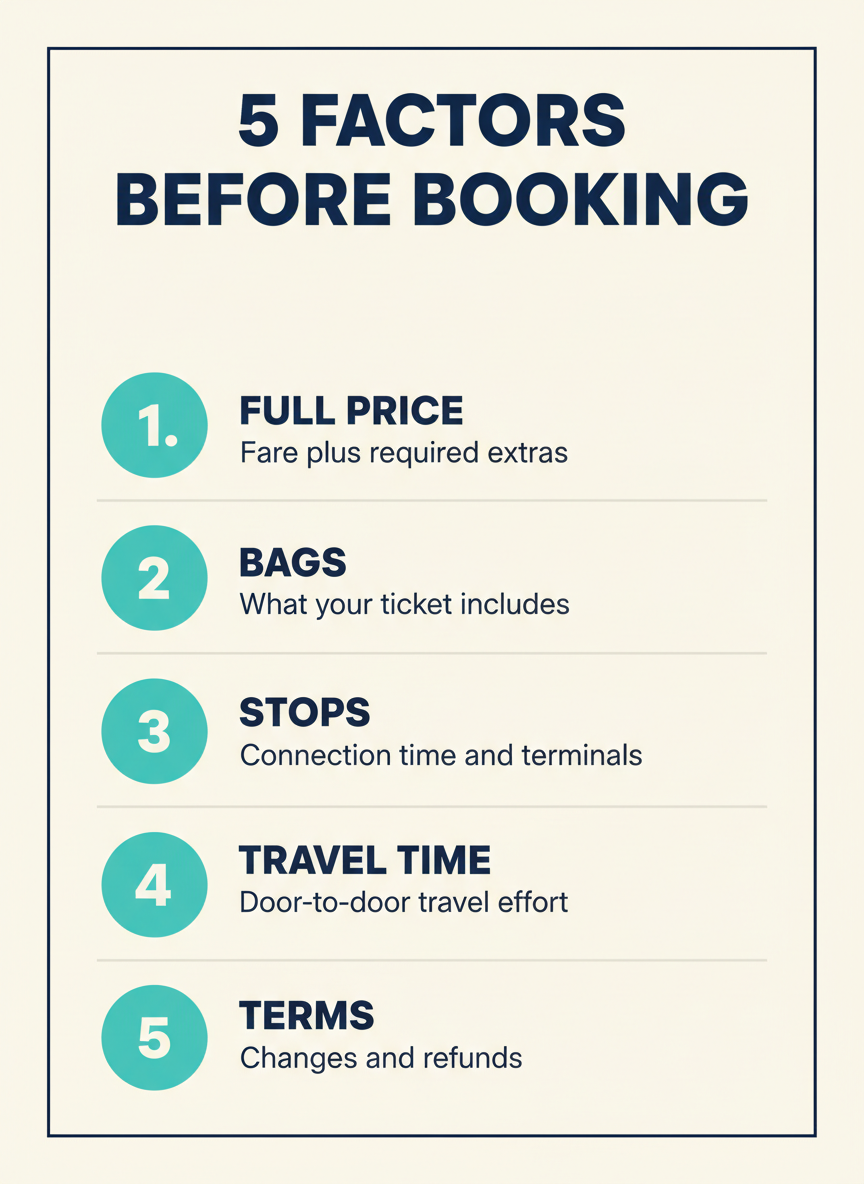
For your next search, compare the same travel dates and passenger count. Assign each candidate a simple practical rating of Poor, Acceptable or Good for each factor. This is a personal planning tool, not a rating of airline safety or a promise of service.
| Factor | Flight A | Flight B |
|---|---|---|
| Total cost for your needs | $300 | $255 |
| Baggage and selected seat | Extra purchase | Included |
| Stops | One connection | Nonstop |
| Total journey effort | Longer | Shorter |
| Cancellation and changes | Check precise fare rules | Check precise fare rules |
Notice that the last row cannot be filled responsibly until the traveler reads each exact fare condition. Never invent a refund promise just to complete a comparison.
A 10-minute booking workflow
- Minutes 1–2: enter dates, travelers and nearby airports you are genuinely willing to use.
- Minutes 3–4: filter out unacceptable schedules and stop counts.
- Minutes 5–6: choose only two or three finalists and compare luggage and seat needs.
- Minutes 7–8: calculate each true cost and read cancellation and change terms.
- Minutes 9–10: check operating airline, airport codes, passenger details and total amount before paying.
Common flight-search mistakes
- Choosing a very short connection without accounting for terminal changes or possible delays.
- Comparing one basic-economy fare to a more flexible ticket as if they include the same benefits.
- Forgetting that optional baggage and seat expenses may differ for each traveler.
- Assuming that third-party sellers apply airline booking rules in precisely the same way.
- Trusting an old article about ancillary fee disclosures without checking current DOT guidance.
- Booking the lowest price without checking the transportation needed after arrival.
Frequently asked questions
Is a nonstop flight always worth the extra money?
No. It depends on the price difference, total travel time, missed-connection risk and your personal priorities. For travelers who need easier connections or a simpler travel day, a nonstop option may be especially valuable.
Is the fare I see in search results the final amount?
Mandatory fees and taxes generally belong in the advertised full airfare, but optional extras such as bags and seats may still increase the amount you pay. Check the entire checkout breakdown before committing.
Do all U.S. airlines have the same cancellation policy?
No. Fare conditions differ by airline, ticket type, route and seller. Some DOT consumer protections apply across covered purchases, but not every cancellation qualifies for a refund.
Can I ask for airport assistance before I book?
You can contact an airline about the assistance you need and available services before purchasing. Relevant disability accommodations have protections under DOT rules, but specific circumstances and safety requirements matter.
The bottom line
Use flight search as a shortlist builder, not an endless price chase. Compare total costs, baggage, connections, schedules and the exact fare terms for the same trip. A slightly higher-looking price can sometimes produce a cheaper and more comfortable overall journey; only a complete side-by-side comparison can tell you.
Official sources and date checked
- DOT — Airline Rules and Fares — full-fare and optional-fee disclosure.
- DOT — 2026 Ancillary Fee Disclosure Final Rule — current regulatory framework.
- DOT — Buying a Ticket — 24-hour hold/cancellation conditions.
- DOT — Refunds — eligible cancellations and significant changes.
- DOT — Airline Cancellation and Delay Dashboard — voluntary service commitments.
Fact-check date: October 9, 2026. Airline prices, schedule options, refunds and disclosure rules can change. Verify with the operating airline and ticket seller. Dollar amounts above are illustrative only.
Editorial statement: This article is independent general travel information. No airline, travel agency or ticket seller paid for inclusion in this draft; the site does not sell or book airline tickets.
Related travel guides
- Carry-On Packing Essentials — a practical guide for the next stage of planning.
- Request Airport Assistance — a practical guide for the next stage of planning.
- Build a Realistic Vacation Budget — a practical guide for the next stage of planning.
Need a different topic? Browse all travel guides or start with our five-step overview.

