

First-Time Cruise Planning Checklist After 50
Compare routes, entry documents, cabins and your boarding plan.
A first cruise can be an enjoyable way to explore several places without changing hotels every day. It also comes with details that surprise first-time passengers: cabin location, port schedules, boarding procedures, travel documents, and extras that may not be included in the advertised fare. This research-based guide is designed for U.S. adults over 50 and anyone who prefers a clear, comfortable first-cruise plan.
Quick answer: Before paying, confirm the itinerary and all destinations, check passport and visa requirements for every traveler, choose a cabin based on actual accessibility and noise preferences, read the full cruise fare terms, and plan an unhurried trip to the departure port.
1. Pick an itinerary that fits your travel style
Start with how long you want to be away, how much time you want to spend at sea, and the type of places you wish to visit. A short round-trip sailing can be a convenient introduction, but even short cruises may include international ports and have entry-document requirements.
- Decide on a realistic trip duration and where you are willing to depart.
- Compare the number of port days with days at sea; more stops do not always mean a more relaxing trip.
- Look at what each port visit involves, including walking, tenders, ground transportation, and time to return to the ship.
- Review the ship’s layout and published facilities—do not infer accessibility or quiet from promotional photos.
- Check weather and seasonal conditions for every destination, then build flexibility into your expectations.
Weather, port operations and maritime safety can change a ship’s course or stop schedule. Treat the itinerary as the planned route, not a promise that every port will be visited.
2. Check travel documents well before booking
Document rules are especially important for cruises because even sailings departing from the United States may visit foreign destinations. For U.S. citizens, some qualifying closed-loop cruises—those that begin and end at the same U.S. port under relevant Western Hemisphere rules—allow certain alternative documents for return by sea. Eligibility and accepted documents depend on the itinerary and individual circumstances. A closed-loop exception is not a guarantee that every destination or cruise line accepts the same paperwork.
U.S. Customs and Border Protection explains the closed-loop distinction in its official cruise document guidance. Cruise lines may impose their own boarding documentation requirements. Confirm all documents directly with the cruise line and destination authorities rather than relying on a single general travel article.
Practical safeguard: The U.S. Department of State recommends international cruise passengers travel with a valid passport. If an emergency requires leaving a ship overseas and flying home, traveling without one can make matters difficult. A passport book may be necessary for international air travel even when a qualifying sea itinerary permits alternatives. See State Department Cruise Ships guidance.
- Verify your passport expiration and destination-specific validity requirements.
- Check whether visas, travel authorizations or special entry rules apply at each planned port.
- If you are not a U.S. citizen, verify rules for your own nationality and U.S. immigration status—closed-loop guidance for U.S. citizens may not apply to you.
- Confirm that reservation names match travel documents exactly.
- Allow enough time for passport renewals, visas, and other applications; a 30-day checklist may be too late for some document issues.
3. Compare the full cruise price, not only the cabin fare
A low advertised cruise price may not represent the total you will actually spend. Read the exact package terms for port expenses, government charges, gratuities or service charges, beverages, internet access, restaurants, spa services, shore excursions, travel to the departure port, and transportation home.
| Sample 5-night cruise cost for two | Illustrative amount |
|---|---|
| Sample cruise package | $1,200 |
| Gratuities or service charges if not included | $180 |
| Transportation to/from port | $220 |
| Optional excursion budget | $180 |
| Drinks and internet not included | $120 |
| Contingency | $150 |
| Total planned trip budget | $2,050 |
The amounts above are fictional examples and not quotes for any current sailing. Always check which fees are already included in the package and avoid double counting. A refundable deposit, an onboard hold, and an actual additional charge are not the same thing.
4. Choose a cabin for your actual needs
A cabin in a convenient area may be a better value than a cheaper room that creates an inconvenient walking route. Compare deck maps with the locations of elevators, restaurants, entertainment venues and outdoor areas. Read recent reviews carefully, keeping in mind that noise and movement can vary by deck and itinerary.
- Room location: check walking distance to elevators and any venues that matter to you.
- Motion: people concerned about movement sometimes prefer cabins nearer the ship’s center and lower decks; conditions vary and no placement guarantees a motion-free trip.
- Light and view: compare inside cabins with ocean-view or balcony cabins according to your preferences and budget.
- Accessibility: ask for precise cabin features and boarding or shore assistance rather than assuming every ship or cabin has the same setup.
- Fine print: review whether a guaranteed cabin category means the cruise line chooses your final room assignment.
Ask the line to confirm any medically necessary or accessibility-related accommodation and whether it is available for your specific itinerary. Do not disclose more sensitive information than is needed to arrange the request.
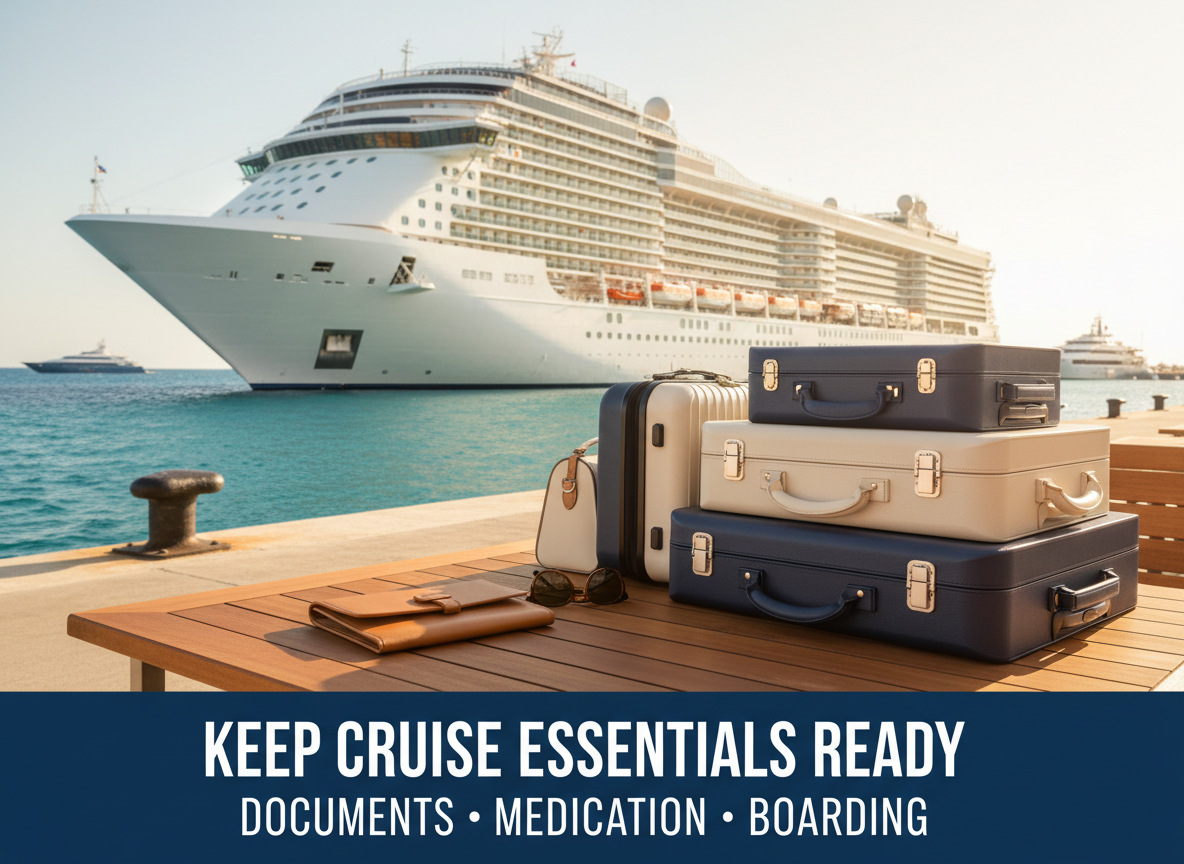
Keep important documents and essential items accessible rather than placing them in checked or collected luggage.
5. Check health guidance before sailing
Cruise environments bring many passengers and crew together in shared spaces. CDC’s Vessel Sanitation Program (VSP) publishes hygiene advice, ship inspection information, and guidance for responding to gastrointestinal illness onboard.
CDC recommends frequent handwashing, especially after using the restroom and before eating, and promptly reporting symptoms to the ship’s medical center. See CDC Tips for Healthy Cruising. Avoid treating every cruise as high risk, but prepare sensibly for shared dining and common areas.
- Check destination-specific CDC travelers’ health recommendations well before departure.
- If appropriate for your health circumstances, discuss motion sickness, medication storage, vaccinations or other preparations with your healthcare professional.
- Confirm whether the ship offers medical services and what charges or payment policies apply.
- Pack essential medicines, mobility items and other personal necessities in a bag you keep with you.
- Wash hands regularly and contact the onboard medical team promptly if you become ill.
CDC also provides ship inspection scores and outbreak reports, but an inspection score or past report is not a prediction of whether a particular future voyage will have an outbreak. Research available information without drawing unsupported conclusions. See CDC Vessel Sanitation Program overview.
6. Understand embarkation day
Follow the specific time window and check-in instructions issued by your cruise line. Arriving at a departure city before sailing can provide a buffer against travel delays, but it may add hotel and meal costs. Some travelers prefer an overnight stay; no single timing rule suits every itinerary.
- Complete online check-in according to the cruise line’s instructions and save boarding passes as directed.
- Locate the correct terminal—not just the general port address.
- Review baggage tagging and handoff procedures.
- Keep passport or accepted documents, medications and irreplaceable valuables in your personal carry-on.
- Confirm port transportation and allow extra time for traffic and security.
- After boarding, locate the muster station and follow the ship’s required safety briefing and drill instructions.
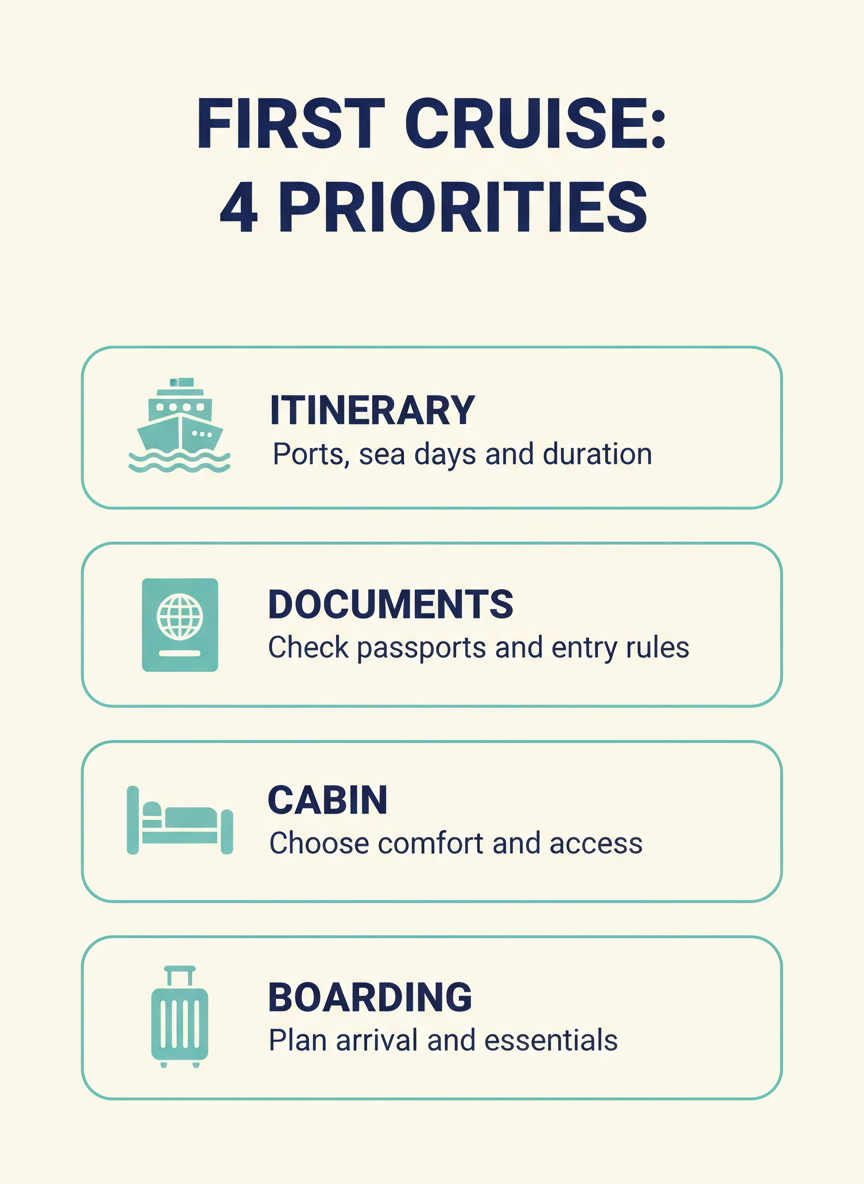
A first-cruise visual planning map
7. Plan shore days without overloading the schedule
Shore excursions can be a highlight, but every port day does not require a paid tour. Look at the actual length of the stop, transportation time, walking conditions, entry fees and ship return deadline. Remember that the ship’s time may differ from local shore time; follow the cruise line’s published instructions.
- Choose one priority activity per port and allow time to return.
- Verify transport arrangements if you book independently of the cruise line.
- Check physical activity levels and accessibility descriptions before buying an excursion.
- Carry the ship’s emergency contact details and follow local travel advisories.
- Use appropriate sun protection, water and clothing for the destination.
8. Keep cancellation and insurance decisions separate
Cruise deposits, final payment dates, cabin changes, missed embarkation and shore excursion refunds can each have different terms. Read your specific fare contract before you pay. Travel insurance, if you choose it, is separate from a cruise line’s standard booking conditions and may contain exclusions, claim deadlines and limits. Do not assume every delay, illness or itinerary change is covered.
Final first-cruise checklist
- □ Itinerary and all ports reviewed for dates, weather and travel advisories.
- □ Travel documents and nationality-specific entry requirements confirmed.
- □ Total cost reviewed, including services and transport not included in fare.
- □ Cabin location, accessibility and comfort features verified.
- □ Cancellation terms and final payment date saved.
- □ Destination-specific health preparation reviewed.
- □ Port transport and boarding window planned.
- □ Essential documents, medicines and valuables packed in a personal carry-on.
- □ Emergency contact information and ship instructions saved offline.
Frequently asked questions
Do I always need a passport for a cruise from the United States?
Not every qualifying closed-loop itinerary requires a passport book for a U.S. citizen returning by sea, but rules are specific and exceptions have limits. U.S. CBP, the destination and the cruise operator must all be checked. The State Department strongly recommends carrying a valid passport in case an emergency forces international air travel.
Are gratuities always included in the cruise fare?
No. Some packages include gratuities or service charges while others list them separately or apply onboard charges. Review the actual total price and service policies for your booking.
Is a cruise ship’s medical center the same as a hospital?
No. Capabilities and staffing vary, and charges may apply. If you have medical needs, seek professional guidance and check what care the specific ship can provide before traveling.
Should a first-time cruiser pay for every shore excursion?
Not necessarily. Prioritize the destinations and experiences most meaningful to you. Consider budget, access, ship return time and the options for exploring independently.
Official references and editorial transparency
- U.S. Customs and Border Protection — Cruise Travel Documents (closed-loop cruise definition and U.S. citizen documentation).
- U.S. Department of State — Cruise Ships: Safety Tips (passport recommendation and risk of overseas emergency travel).
- CDC — Tips for Healthy Cruising (hygiene and illness reporting on ships).
- CDC — Vessel Sanitation Program (ship inspection, health monitoring and outbreak information).
Editorial review date: October 9, 2026. Cruise documentation, departure times, fares, itineraries and public health recommendations change. Check official authorities, the carrier and every port of call for your actual voyage.
Disclosure: This is research-based general travel information. It does not claim personal cruise experience, arrange bookings or provide individualized legal, medical, insurance or financial advice. All price examples are fictional.
Related travel guides
- Organize Travel Documents — a useful companion guide.
- Build a Realistic Vacation Budget — a useful companion guide.
- Complete Travel Planning Checklist — a useful companion guide.
- Compare Travel Insurance After 50 — review cancellation, emergency medical cover and exclusions.
Explore all travel guides or follow our five-step starting plan.

