

HOTEL RESORT FEES: KNOW THE FULL PRICE
2026 U.S. fee rules · Parking · Deposits · Refunds
Quick answer: In the United States, short-term lodging sellers that advertise a price must prominently show a total that includes known, calculable mandatory fees upfront under the Federal Trade Commission’s Rule on Unfair or Deceptive Fees, effective May 12, 2025. Government taxes and genuinely optional extras may be added later, but the final amount must be disclosed before you are asked to pay. The rule does not ban resort fees. It changes how prices and fees must be presented.
Travel Ready After 50 focuses on the real decisions travelers make: not only whether a hotel photograph looks comfortable, but what the stay costs, what will temporarily be held on a card, and which services are actually available when you arrive. This guide is independent consumer information, not a judgment that any named hotel violates the law.
Find the hotel price question you need
2026 hotel price transparency: what the FTC rule actually says
The FTC’s official fee rule FAQ explains that covered businesses selling short-term lodging must disclose the advertised total price inclusive of mandatory fees, except for a narrow group of permitted exclusions. The total must be the most prominent price in most comparisons. The rule applies to relevant hotels, vacation rentals, and the online third-party platforms or travel agents that offer these stays.
For example, a mandatory daily resort fee, required cleaning fee or another fee you cannot reasonably avoid generally belongs in the upfront total. A genuine optional choice, such as a parking package you decide to add, can change the price later. Applicable taxes or other government charges may be excluded from an initial total but must be clearly disclosed before payment. The displayed rate is not necessarily the entire final charge if taxes or optional add-ons still apply.
Importantly, the rule does not require hotels to stop charging resort fees, fix the amount of an advertised fee, or give travelers a blanket right to cancel after they have paid. It prohibits misleading total-price presentation. It is also a U.S. rule for the covered transactions, not a uniform worldwide hotel-pricing law. When staying abroad, consult the actual destination and booking platform’s rules.
Six practical checks before reserving your room
1. Record the upfront total for the full stay
Set the real travel dates and guest count, select the actual room and compare total stay prices rather than just a nightly headline. Ask whether the listed total includes all compulsory service, resort or cleaning fees. If the number changes when you proceed, identify the specific new item and whether it was mandatory from the start. Keep a screenshot of the priced offer and the terms displayed.
2. Separate government taxes from mandatory hotel fees
A genuine government occupancy or sales tax can be disclosed later under the FTC framework, as long as it is clearly included in the final amount before payment. A hotel’s mandatory property-service fee is not made into a government tax simply by using an official-sounding name. Read how each amount is described and compare it with the FTC examples rather than assuming everything called a ‘fee’ should have the same legal treatment.
3. Look carefully at optional services you may actually need
Parking, breakfast, use of a particular facility, pet arrangements and late checkout can change the final cost. Ask about what is included with your room, particularly when you will rely on an elevator, hotel shuttle or breakfast before an early departure. Some accommodations require payment for an extra service; whether a charge is truly optional depends on the booking terms and circumstances. Obtain written confirmation rather than relying on a photograph of a parking lot or restaurant.

4. Ask whether a deposit is a charge or a temporary card hold
A hotel may ask for an incidental authorization hold on a card at check-in. A temporary hold can reduce your available credit or funds without being a final purchase, but release timing depends on the hotel and the issuing bank. A nonrefundable fee or required prepayment is different. Ask which category applies, the amount held, when any release is initiated, and what documentation you receive. Never plan your entire travel budget assuming held funds return immediately.
5. Check the cancellation deadline and payment recipient
Confirm which entity charges your card: the hotel, the online agency, or a local property manager. Check whether the reservation is refundable, when a deadline applies in the property’s local time, whether you pay now or at the hotel and what happens after a no-show. The FTC’s travel scam advice recommends independently checking travel sellers and cancellation terms and avoiding suspicious requests to pay by wire, gift card or cryptocurrency.
6. Confirm practical room conditions as well as price
If you prefer a particular bed height, a quiet room, a working elevator, a walk-in shower, a refrigerator or a short route from reception, ask about the actual room category before paying. Accessibility amenities may differ by room or building; the property should explain what it can specifically provide. Our comfortable hotel selection guide covers room and location questions in depth.
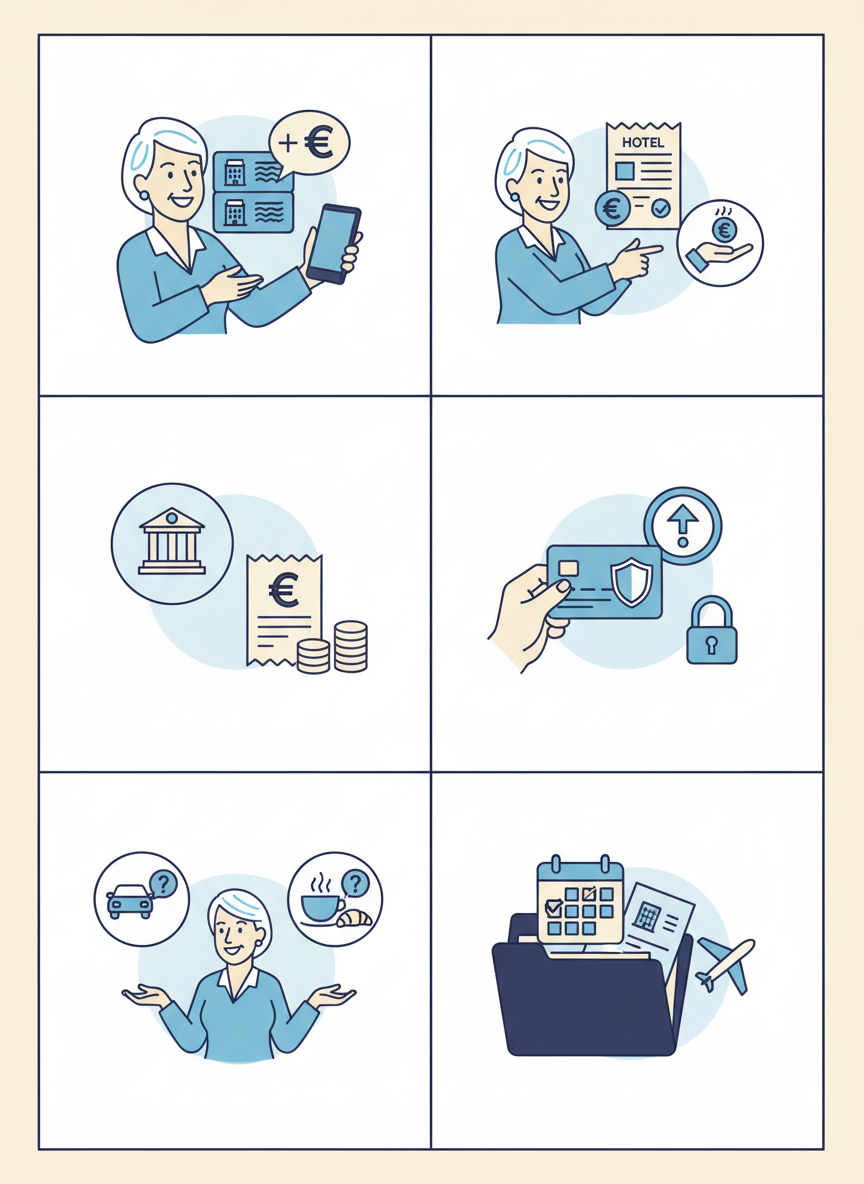
Fee, tax, deposit and authorization hold: four different things
- Mandatory fee: unavoidable hotel, cleaning or service charge imposed by a covered seller; under the FTC rule it normally belongs in the advertised total.
- Government tax: a qualifying tax or other government charge that may be excluded from the initially displayed total but must appear in the final amount before payment.
- Optional extra: a genuine elective purchase such as a selected additional service; choose it knowingly and review the updated total.
- Refundable deposit or authorization: a security amount or temporary card hold subject to the booking’s terms and payment-network processing; verify whether and when money becomes available again.
Before check-in, you can ask a short question: “Please confirm the final room amount, whether any compulsory fees remain, and whether the incidental amount is an actual charge or an authorization hold.” Save the staff answer. If something is unclear, ask the seller to itemize it; do not assume a deposit and a resort fee are interchangeable.
How to compare two hotels without a misleading nightly-rate shortcut
Imagine Hotel A advertises a lower headline nightly figure but has required property charges, paid parking and a complicated cancellation deadline. Hotel B shows a higher-looking nightly number, includes parking, and lets you cancel before a stated date. After selecting the exact dates and services, Hotel B could have the lower total cost or the more flexible contract. These examples are hypothetical and are not actual hotel prices.
Use a simple comparison sheet containing the full stay total before any elective extras, estimated final total including disclosed taxes and selected add-ons, expected check-in card hold, parking or breakfast costs, cancellation deadline and facilities you need. Compare like-for-like rooms and dates. Check whether the displayed currency and included tax treatment match.
If a mandatory fee appears for the first time only at the last payment step on a covered U.S. short-term lodging offer, preserve a screenshot and ask the seller to explain. You can submit concerns through the FTC ReportFraud portal. A complaint does not automatically reverse a charge; preserve receipts and also contact the card issuer or seller to discuss a billing dispute.
A printable mental checklist for checkout
- Is this the price for the entire booking, not a one-night teaser?
- Are unavoidable resort, cleaning and service fees already accounted for?
- What taxes and elected services will be added before payment?
- Is a security deposit a permanent charge, refundable prepayment or temporary hold?
- When is the cancellation deadline, in local time?
- Does the exact room meet my preferences and any required accessibility features?
- Who will charge my card, and have I kept the confirmation?
Frequently asked questions
Are resort fees illegal in the United States in 2026?
No blanket ban exists under the FTC fee rule. The rule focuses on clear upfront total pricing and truthful fee disclosure for covered transactions, not on prohibiting a particular type or amount of resort fee.
Does the upfront price have to include taxes?
Qualifying government taxes may be excluded from the initial total if clearly disclosed before payment; the final amount must be prominently presented before you are asked to pay. Read the FTC FAQ for the covered exceptions.
Is every hotel deposit a resort fee?
No. An incidental authorization, refundable deposit and mandatory service charge have different meanings. Ask whether the amount will be captured as payment and when funds may be released.
Does the FTC rule apply to a hotel I book in another country?
Do not assume all foreign lodging transactions are covered in the same way. Whether the rule applies depends on the transaction and relevant jurisdiction. The lodging provider’s terms and local consumer law also matter.
Will the rule guarantee a refund if I cancel a nonrefundable room?
No. A clearly disclosed cancellation policy and fee transparency are separate issues. Read the contract and ask for written exceptions or a flexible rate before booking.
Official sources and related guides
- Federal Trade Commission — Rule on Unfair or Deceptive Fees: official FAQ.
- Federal Trade Commission — May 12, 2025 implementation announcement.
- Federal Trade Commission — Avoid travel scams and suspicious booking methods.
- Choose a comfortable hotel after 50 · Build a practical travel budget · Start Here.
Editorial review: October 11, 2026. This is general U.S. travel-consumer guidance, not legal advice or a review of a specific hotel. The FTC’s published guidance and each actual transaction’s terms govern the details. Images are AI-generated explanatory illustrations, not records of a real stay.

