

GUIDED TOURS THAT FIT YOUR PACE
After 50 · Real route · Rest stops · Fair terms
Quick answer: Choose a guided day tour by its actual route, walking surface, longest stretch without seating, stairs and transport steps, bathroom access, group size, return timing and cancellation terms—not by a vague badge that says ‘easy’ or ‘senior friendly.’ Ask for specific written details before paying. Travelers after 50 have different goals and abilities; a good tour is one that respects the experience you personally want.
Travel Ready After 50 exists to turn broad travel promises into practical questions you can verify. Rather than ranking tour companies we have not tested, this article gives you a reusable checklist for a city walk, museum visit, countryside excursion or guided heritage day.
Find your tour-booking question
Why “low difficulty” is not enough to describe a day tour
A two-hour tour labeled ‘easy’ might involve a short flat walk with frequent seating—or two miles of cobblestones, several flights of stairs and long standing periods. A minibus outing may include steep vehicle steps, a long walk from the parking area to the attraction or no bathroom stop. A tour operator’s self-assigned activity level can be useful context, but it is not an accessible-route certification.
The U.S. Department of State’s international accessibility guidance notes that accessibility rules differ from country to country and encourages travelers to check facilities and accommodations with providers before a trip. That supports a simple principle: ask about the exact service and route you will use, not whether an entire destination is described as accessible.
Seven questions to send a tour company before booking
1. What is the total walking distance—and the longest continuous stretch?
Ask for both. A trip with a one-mile total walk broken into several short sections can feel different from the same distance without a pause. If the company cannot estimate, request the most accurate description it can provide. Ask whether the group pace is fixed, whether you can stop early, and whether it is possible to meet the group at the next venue.
2. Are there stairs, slopes, uneven surfaces or narrow paths?
A tour may include accessible transport but an inaccessible final destination. Ask about steps at entrances, cobblestones, high curbs, gravel, steep hills and handrails. A historic building may have limited entry into upper levels. If you use a mobility aid or simply prefer fewer stairs, check exactly where a step-free alternative exists—not a generic assurance that ‘most people manage.’
3. How often can I sit, and where are the restrooms?
Ask for the longest period of standing, planned seating breaks, restroom availability, whether the restrooms are accessible and the availability of drinking water. A long museum explanation while standing still can be more tiring than a pleasant slow walk. Note if rest stops depend on shopping purchases or cafés rather than public facilities.
4. What does boarding the bus, boat or other vehicle involve?
Confirm the entrance height, steps, grab rails, lift availability and travel duration. A small van that meets the group close to a hotel can still have a high first step. Boats may require moving gangways or uneven boarding depending on water level. Ask the operator for the specific vehicle or equipment planned on your date and what happens if the equipment changes.

5. What is the actual group size, language and pace?
A smaller tour might allow more questions and individualized pacing, but a ‘small group’ label can mean different numbers. Ask for the scheduled maximum number of participants, whether the guide uses amplified audio, the language used, and how the tour handles travelers who need a shorter route. A guide should know which elements are essential and which are optional.
6. What does the final price include, and what happens if the plan changes?
Confirm whether admission tickets, transport, accessible arrangements, water, tips, meals, pickup and required equipment are included. Read the cancellation and refund policies in writing, including weather-related cancellation, minimum group size and missed pickup. The Federal Trade Commission’s travel guidance advises researching the seller and getting cancellation and refund policies before you pay. Be wary of pressure to send money by gift card, wire transfer or cryptocurrency to an unverified intermediary.
7. How do pickup, drop-off and a flexible early exit work?
The meeting point could be a hotel lobby, a location across several lanes of traffic or a distant bus stop. Ask for the precise meeting address, earliest check-in time, staff contact, expected end point and estimated arrival back. If you would prefer to skip the most strenuous segment, will the operator allow it, and does it affect transport or the price? Confirm instead of assuming.
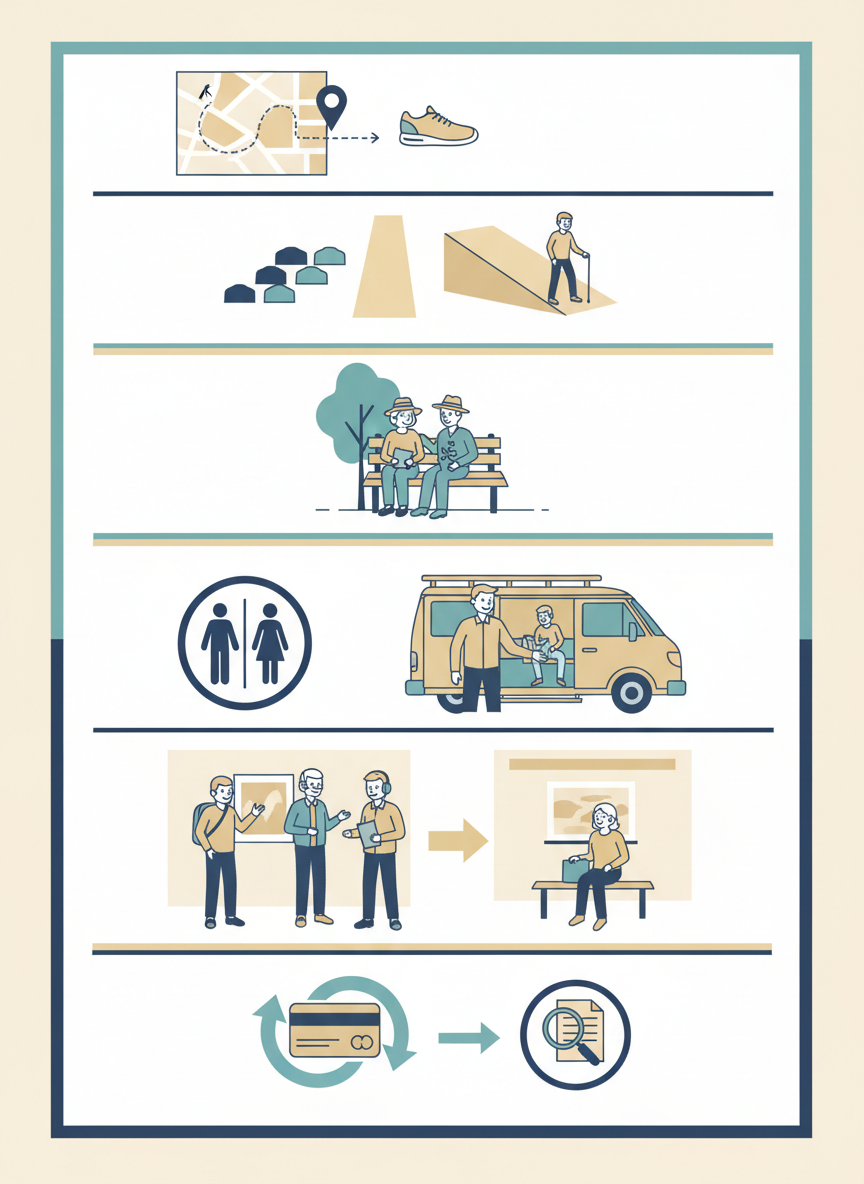
A sample way to compare two tours fairly
Imagine two equally interesting historic city excursions. Tour A is cheaper and starts a long distance from your hotel. It involves a continuous 45-minute standing segment and a museum entry ticket that must be purchased separately. Tour B is a little more expensive but includes a closer pickup, planned seated breaks and the museum ticket. Comparing only the advertisement’s headline price would hide the difference. These are hypothetical examples, not prices from tested companies.
- Base tour: displayed per-person price and booking fees.
- Meeting point: taxi, transit or parking cost to reach pickup.
- Admissions: what is included and what attractions require an extra ticket.
- Meals and water: whether you must buy food along the route.
- Rest and mobility needs: whether a necessary service is included, available by request or unavailable.
- Changes: written cancellation deadlines, weather rules and refund method.
- Return: final destination and any transport cost back to your hotel.
A high price does not guarantee comfort or accessibility. A low price does not automatically make a tour unsuitable. Ask which specific details account for the price, and decide based on what matters to your trip.
Pick the style of guided experience that fits your day
Shorter museum tour
A museum-led or small-group visit can reduce the amount of route planning required. Verify whether chairs are available in galleries, whether the talk takes place while standing, and whether the tour is accessible. Our easy city sightseeing guide explains how to combine transit and museums without packing too much walking into a day.
Vehicle-supported city highlights
A vehicle-based city tour may cover a wider area with less walking, but ask how many stops require getting off, the distance from the stop to the sight and whether entering the main attraction involves stairs. Vehicle support alone does not guarantee a step-free experience.
Private or customizable half-day tour
This may be a useful choice for a group with differing interests or a particular pacing preference. But clarify what ‘customizable’ means: can you shorten a stop without forfeiting the visit? What are the additional vehicle and guide fees? Are there restrictions on last-minute changes?
Self-guided alternative with optional local guide
You may prefer a manageable landmark visit, one nearby café and a pre-booked local guide for a single attraction. This allows rest time and reduces dependence on a large group’s schedule. The goal is enjoyment and flexibility, not completing the largest possible number of activities.
What to write to the operator before paying
A simple message is enough. For example: “We would like the [date] tour for two adults. Could you confirm the total walking distance, longest continuous walk, number of steps or slopes, planned seated breaks, restroom stops, vehicle boarding height, included tickets and cancellation deadline? We would also appreciate the exact meeting point and any shorter-route option.” A specific answer is more useful than a generic ‘suitable for seniors’ label.
Keep the written reply and final reservation. If an operator refuses to describe important physical features or insists on immediate payment to an unrelated personal account, compare another provider. The FTC’s 2026 travel scam guidance gives practical signs of fraudulent travel offers.
Frequently asked questions
Does age 50 mean I need a special slow-paced tour?
No. Many travelers in their fifties, sixties and later years enjoy demanding activities. Choose based on your own interests, preferred pace, route difficulty and accommodation needs rather than age alone.
Does “wheelchair accessible” guarantee every stop is step-free?
Not necessarily. Different segments of a trip and different destinations have different infrastructure. Request information about each vehicle, attraction entrance, restroom and transfer, along with the specific mobility device you use.
Do operators have to allow my own guide or mobility aid?
Requirements depend on location, operator type, destination law and the activity. The U.S. State Department warns that accessibility laws vary abroad. Verify a particular accommodation through the operator and official local guidance rather than assuming U.S. standards apply worldwide.
Is a guided tour always better than exploring independently?
No. A guide can provide information and convenience, while a self-paced route may offer more freedom. Compare genuine usefulness, accessibility, total cost and flexibility.
Can I cancel a tour if the description was misleading?
Potential remedies depend on the contract, payment method, consumer law and circumstances. Get written terms and retain relevant correspondence. The FTC provides guidance for spotting suspicious travel offers, but it does not guarantee a refund on every contract.
What if my needs change on the day?
Tell the operator as early as possible and ask about an alternative route, suitable break or safe return. Do not risk your safety just to keep pace with a group or to avoid missing a prepaid attraction.
Official sources and other practical guides
- U.S. Department of State — accessibility planning for international travel.
- Federal Trade Commission — verify travel offers and get cancellation policies.
- Federal Trade Commission — 2026 travel scam advice.
- Easy city sightseeing after 50 · Plan an approachable national park trip · Create a realistic vacation budget · Start Here.
Editorially reviewed October 11, 2026. This guide recommends questions for comparing actual tours; it does not claim a particular company has been inspected or that every location meets one accessibility standard. Physical needs and activities vary by person. All images are AI-generated illustrative scenes, not documented visits.

