

EASIER FLIGHT CONNECTIONS AFTER 50
Check the clock · Bags · Border · Backup
Quick answer: Do not choose a connecting flight by looking at the layover length alone. Check whether all segments are on one protected ticket, whether you must change terminals or airports, whether you need immigration and customs clearance, whether your bags need to be collected or re-checked, and how often a later flight runs. The most comfortable connection is one with a realistic path and a backup—not necessarily the shortest itinerary.
Travel Ready After 50 is written for capable adults who prefer fewer surprises and more control. Age by itself does not determine how fast someone moves through an airport. Walking distance, flight timing, mobility preferences, staff availability and unfamiliar procedures matter more than a birthday.
Jump to your connection question
A 70-minute connection can be easy in one airport and unrealistic in another
Published minimum connection times are airline or airport booking parameters, not promises that every passenger can reach the gate. The scheduled arrival is when the aircraft is expected to reach its arrival point—not necessarily when you walk off the aircraft. Your next boarding gate can close before the flight’s departure time. An accessible transfer, crowded immigration hall or remote terminal bus can change the calculation considerably.
Think in actions instead of a single number: land, leave the aircraft, find the next terminal, perhaps clear border controls, find the right gate, and board. If you need a seat break or assistance with long distances, include it in your plan. There is no reliable universal layover minimum for all travelers or all airports.
Six checks before you pay for a connecting itinerary
1. Confirm one through-ticket or separate bookings
On a single itinerary, airlines may have arrangements for protected connections and rebooking when an earlier leg is delayed. Separate tickets can mean you are responsible for reaching the next airline, checking in again and resolving a missed connection under separate contracts. Ask the actual booking airline whether your flights are issued on one ticket and what support applies if the first leg is late. Do not infer protection merely because a travel app shows both flights on the same screen.
2. Confirm where the transfer really happens
Check whether both flights use the same airport and whether the transfer is in the same terminal, another terminal or a different airport entirely. A connection described as ‘London’ or ‘New York’ can involve a change of airport if purchased as separate legs. Check the official airport maps, internal shuttles, security checkpoints and the walking distance between terminals.
3. Ask about every checked bag at the border
On many international arrivals into the United States, the first U.S. port of entry is where travelers clear customs, even when they are connecting domestically. The U.S. Customs and Border Protection (CBP) guidance generally describes collecting checked bags and taking them through customs before onward travel, although special arrangements and preclearance can change that process. Ask your airline at check-in and confirm the instructions on arrival: never assume you must collect baggage in all cases or that it will automatically reach your final destination.
4. Check security, passport control and boarding cutoff separately
In some airports you may need to pass through security again; at some international arrivals you must complete immigration formalities and possibly obtain transit entry permission. Rules vary with nationality, country, terminal and route. Check the destination’s official immigration policy and the airline’s transfer guidance. A pass through customs is not the same as TSA security screening.

5. Plan the distance, time and assistance you actually want
Study the walking route, available moving walkways, stairs, elevators, terminal trains and rest areas. If you need help with long airport distances or a wheelchair or electric-cart service where offered, request assistance through the airline in advance. It is appropriate to request an accommodation when needed; it is not something every traveler over 50 automatically requires. Our separate airport assistance guide covers questions to ask.
6. Check the fallback flight and the actual refund/rebooking terms
Look at what happens if the earlier flight is delayed. Does the carrier operate another practical flight to your final destination that day, or could you be stuck overnight? Record the operating airline and reliable contact channel. The U.S. Department of Transportation’s airline cancellation and delay dashboard compares airlines’ commitments for controllable disruptions; not every amenity is legally guaranteed and not every cause is controllable.
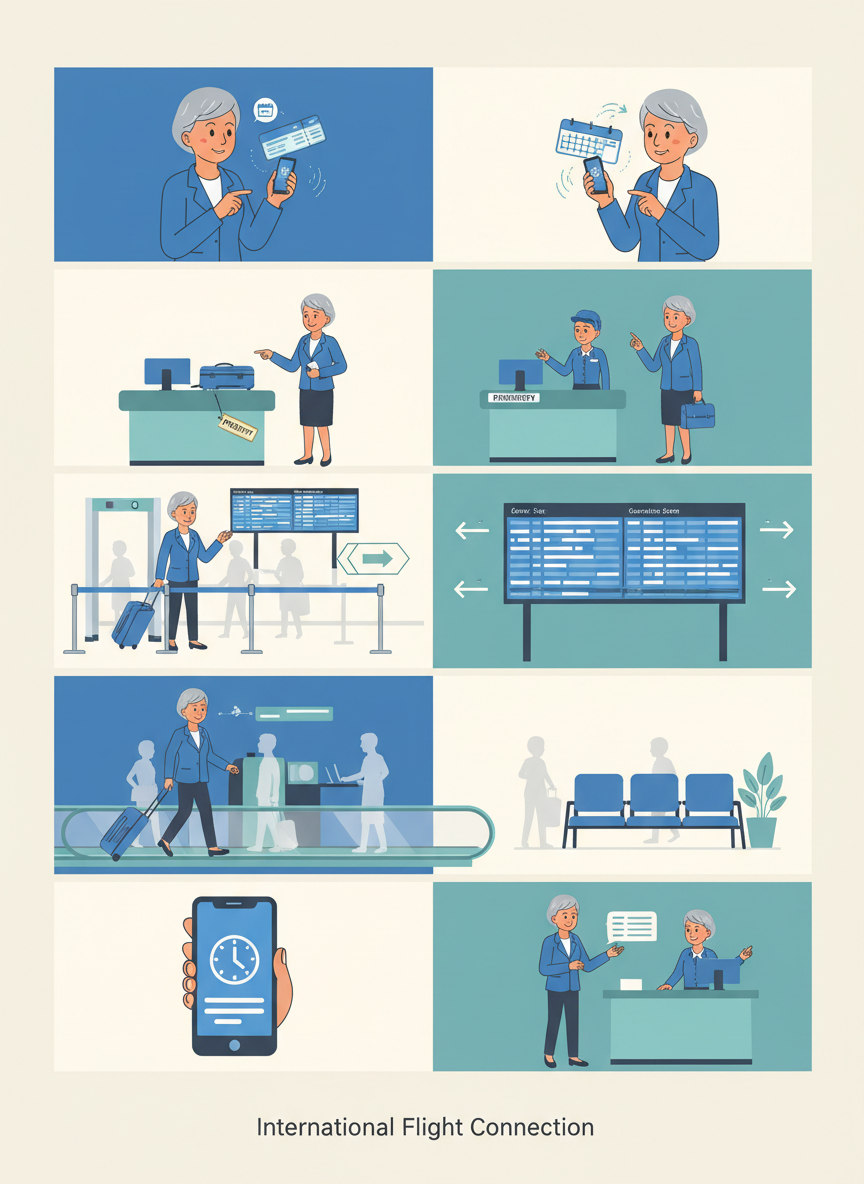
International U.S. connections: three different processes to verify
Regular arrival: CBP generally requires entry clearance at the first U.S. port of entry. Bags may have to be reclaimed and dropped for the next flight. Preclearance: certain foreign airports process U.S. CBP formalities before departure, allowing many arriving passengers to proceed like domestic arrivals. Remote baggage screening exceptions: CBP began piloting an International Remote Baggage Screening initiative in 2025 on select routes, allowing eligible connecting travelers to continue without reclaiming bags unless referred for inspection. Confirm that your actual airport, airline and route participate; these exceptions are not universal.
For example, a U.S.-bound traveler connecting through an airport with U.S. preclearance may complete entry procedures before takeoff; someone arriving from a non-preclearance airport will follow different processing. A third traveler booked on two separate tickets may also have extra check-in steps. This is why a single internet rule like ‘you always collect the bag’ is not dependable.
- Verify before departure: operating airline, luggage tag destination, transit visa or entry permission and next boarding cutoff.
- Ask at the first check-in: “Will I need to collect and recheck this bag at the connecting airport?”
- On arrival: follow the actual airport and CBP staff instructions, even if they differ from an older online guide.
- Prepare: keep a copy of your next boarding pass, itinerary, airline contact and an essential-item kit in your carry-on.
If the first flight is late, what should you do?
Check the airline’s official app or departure boards for the new arrival time and gate. Contact the airline through a trusted channel and explain you have an onward connection; ask whether the next flight is protected on the same ticket and what rebooking options exist. If you bought separate tickets, contact both providers promptly and ask about their specific rules rather than assuming either one is obliged to absorb the other booking’s problem.
The DOT dashboard explains carrier commitments when a U.S. airline causes a controllable cancellation or delay. Refund rights are a separate question, and a passenger who accepts rebooking may have a different remedy from someone who declines travel after a qualifying cancellation or significant change. Our U.S. flight delay and refund checklist explains that distinction.
A practical comparison before purchasing
- Option A — shorter, cheaper: may be suitable if one terminal, no additional border checks, no checked bag recheck and the airport’s connection procedures support it.
- Option B — more time, slightly higher cost: may be more comfortable when changing terminals, waiting for border clearance or traveling with checked bags.
- Option C — overnight near the connection: may make sense for a difficult international transfer or a journey where a missed flight would disrupt an expensive tour.
- No universal winner: compare your own pace, actual route, travel companions, boarding deadlines and backup choices.
Frequently asked questions
How much time should a traveler over 50 allow for a layover?
There is no correct age-based number. Determine the airline and airport minimum, then allow additional time for transfer distance, passport checks, baggage steps, preferred rest breaks and possible delays. Do not trust a universal online rule without identifying your actual itinerary.
Does a single booking guarantee an easy connection?
No. It may provide better protection if a connecting flight is missed under the ticket terms, but airport distances and delays remain real. Read the operating carriers’ connection and rebooking rules.
Must I collect my checked bag when entering the United States?
Often, but there are exceptions, including approved remote baggage screening arrangements and international U.S. preclearance. Ask the airline and obey the current on-site CBP instructions.
Is an airport mobility cart the same as wheelchair assistance?
No. Airport assistance programs differ. Request the service you need through the airline, confirm what it covers and allow sufficient time. Never assume a terminal cart is available on demand.
Do I automatically get a hotel if the airline cancels my connection?
No blanket rule applies. The reason for the disruption, carrier’s commitments, itinerary and location all matter. Check the airline’s current policy and the DOT dashboard.
Official references and related planning
- U.S. Department of Transportation — airline cancellation and delay commitments.
- U.S. Customs and Border Protection — baggage connection guidance.
- CBP — International Remote Baggage Screening exceptions.
- CBP — preclearance explained.
- Compare flights without stress · Request airport assistance · Start Here.
Editorial check: October 11, 2026. General travel planning, not live airline availability, legal advice or a promise of protected rebooking. Border, airline, baggage and gate procedures vary by actual route and can change. Illustrative images were AI-generated; no firsthand airline trial is claimed.

